
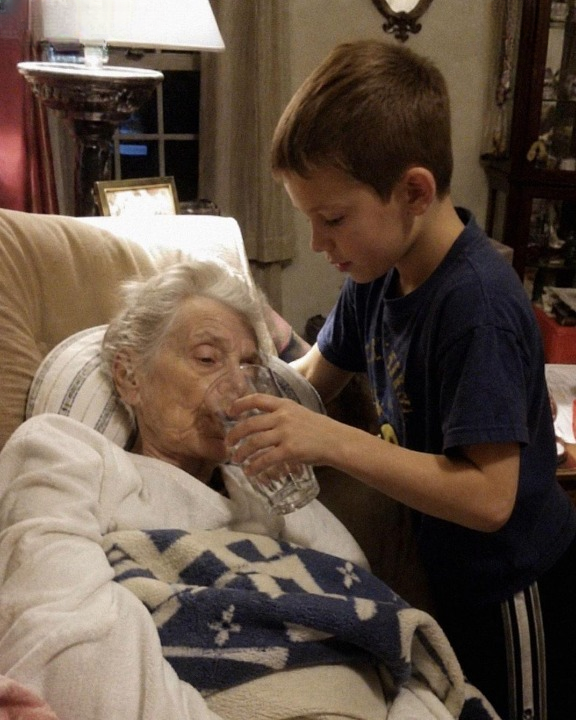
For three years, Harry believed he was simply helping an elderly neighbor who lived alone. But everything he thought he understood about that relationship changed after her house went dark for the last time—and a sealed box appeared in his yard with his name on it.
It began with small moments.
Harry was ten when he first saw Grace struggling outside her modest blue house. She was an elderly woman with a silver bun and slow, careful steps, someone the neighborhood knew but rarely truly saw.
One afternoon, while riding his bike nearby, Harry noticed a taxi drop off her groceries and leave them at the curb. Grace tried to lift the bags herself, but she clearly struggled.
Without thinking too much, Harry rushed over and helped her carry them inside.
Her home was quiet—too quiet. No background noise, no visitors, just stillness and the smell of soap and old books.
That small act marked the beginning.
Harry started stopping by more often, first out of curiosity, then habit. He ran errands, brought food from home, helped clean, and slowly became part of her daily life. Grace resisted at first, but eventually accepted his presence with quiet gratitude.
Days turned into weeks, weeks into years. Harry grew up alongside her aging. She became slower, frailer, while he remained her steady visitor.
They talked sometimes, but often simply shared silence. Over time, Grace revealed pieces of her loneliness—especially the absence of her grandson, who she said she hadn’t seen in years.
Harry never pushed for answers. He just kept showing up.
Then one day, Grace’s house fell completely silent. The lights stayed off, the curtains unmoved. His parents later told him she had passed away.
Harry felt the absence deeply, but said little.
A week later, he found a box in his yard addressed to him.
Inside were a sweater, a photo album, and a letter written in Grace’s handwriting.
In her letter, she told him she had once lost her grandson—not through death, but through distance, pride, and unresolved conflict. She had waited for him to return, but he never did.
She explained that Harry’s presence had filled a loneliness she had long stopped hoping anyone would notice. Every visit, every small kindness, had made her feel less forgotten.
The sweater, she wrote, had belonged to her grandson. She wanted Harry to have it—not as a replacement, but as a symbol of the family she felt he had given her in her final years.
Harry cried as he read it, realizing that what he thought was simple help had meant far more than he understood.
Inside the photo album, he found pictures of Grace’s life, her grandson as a child—and finally, a photo of himself sitting beside her on the porch.
On the back, she had written: “My chosen grandson.”
At her funeral, Harry wore the sweater she had given him. There, he met a man who introduced himself as Grace’s real grandson.
The man told him Grace had written about Harry—that he had been the one who stayed when family did not.
In that moment, Harry understood something important: while he thought he had been caring for her, she had also been shaping him.
She had shown him that love and family are not always defined by blood, but by presence—by who chooses to stay when it would be easier to walk away.