
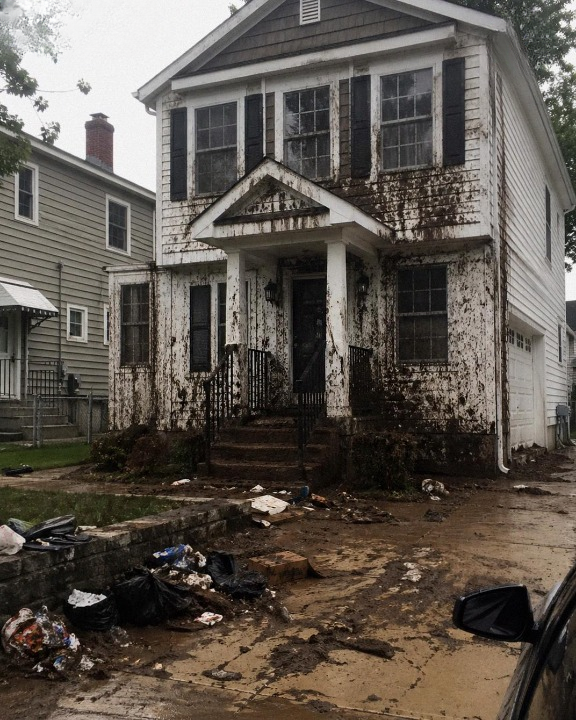
She believed the worst thing her neighbor could do was secretly smear mud and garbage over the last remaining piece of her parents’ legacy during the night. She was wrong. By morning, the entire neighborhood was heading toward his house with a determination he never expected—and something he had never prepared for finally caught up with him.
I’m 21, and the house my parents left behind is all I have.
Since they died in a car accident two years ago, I’ve been doing everything possible to hold onto it—working multiple jobs, leaving university, and scraping by just to keep the place from falling apart. It’s old, imperfect, and constantly in need of repairs, but it’s mine in every meaningful way.
It still carries them. Their routines, their memories, their presence in the smallest details. Losing it would feel like losing them all over again.
My neighbor, Gordon, never liked us.
Even when my parents were alive, he was hostile—petty complaints, constant criticism, and a need to assert control over everyone around him. He lived in a large, wealthy house and acted like the street belonged to him, using intimidation and minor harassment whenever he could.
After my parents passed, it only got worse. He seemed to see me as an easy target.
At first it was small things—calls to the city, passive-aggressive remarks, and strange interference with my property. I tried ignoring it, then tried being polite, but nothing changed.
Men like him don’t stop because you ask nicely.
A few days ago, things escalated.
While I was outside, he passed by and mocked me, twisting my grief into something cruel and personal. I answered back, and I could see immediately that I had struck a nerve. The expression on his face wasn’t anger—it was calculation. The kind that means retaliation is coming.
I should have gone inside then.
I didn’t.
The next morning, I stepped outside and froze.
My house had been deliberately vandalized—covered in mud, trash, and debris. It wasn’t random. It was targeted, thorough, and meant to humiliate. Every surface felt desecrated.
And Gordon stood nearby, watching with satisfaction, as if it were nothing more than a lesson.
Then he went back inside, leaving me alone in the aftermath.
I started cleaning.
Slowly. Exhaustively. Trying to undo what I could while fighting back tears and exhaustion. It felt like punishment, like he wanted me to break while I repaired what he had destroyed.
I thought I was alone.
I wasn’t.
A few hours later, I heard movement—footsteps, voices, then people appearing at the edge of the street.
One by one, neighbors began walking toward my house. Some carried bags, others equipment, and behind them came something I couldn’t immediately process.
They weren’t just arriving to help.
They were arriving prepared.
Mrs. Keane, one of the neighbors I knew, stepped forward first.
She told me I wasn’t going through this alone. Then she revealed something I hadn’t understood: Gordon had been doing this to multiple people for years—small acts of damage, intimidation, and abuse that had never been fully confronted.
This time, they had all brought proof.
Records, footage, complaints, and documentation—everything he had gotten away with in isolation was now connected.
And then the truth became clear.
This wasn’t just neighbors helping clean a mess.
This was a coordinated response from an entire community that had finally decided they had enough.
By the time authorities arrived, everything had changed.
Evidence was handed over. Surveillance footage was shown. Patterns of harassment and property violations were exposed. Even his illegal construction work was brought to light.
For the first time, Gordon couldn’t talk his way out of it.
By the end of the day, the damage he had caused was being repaired, not just on my house—but in the way the neighborhood treated him entirely.
And I realized something I hadn’t understood before:
I had never been as alone as I thought.
He had relied on isolation.
They relied on each other.
And in the end, that made all the difference.