
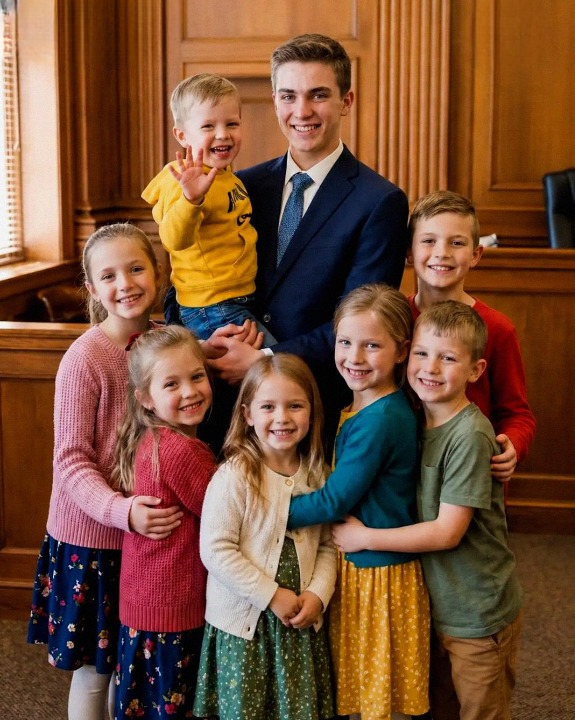
I was eighteen when I fought to keep my seven siblings together after our parents died. For three years, I believed I was barely keeping us afloat. Then my youngest brother discovered an old photograph, and the message written on the back changed everything I thought I knew about my family.
It started the day two police officers showed up at our door.
Inside, the house was chaos—kids laughing, arguing, and scrambling through an ordinary afternoon that suddenly didn’t feel ordinary anymore. Then one officer asked for me by name, and I already knew what was coming before he said it.
There had been an accident. Our parents hadn’t survived.
Just like that, I went from being eighteen to being the only adult left for seven children.
Days later, a social worker told me what I feared most: the kids would have to be split up. I pushed back, begged, argued—anything to keep them together. I was young, broke, and overwhelmed, but I refused to let my family be separated.
In court, our aunt offered to take some of them. She spoke like she was doing us a favor, but I knew it would fracture us for good. My siblings chose me, and against the odds, I was granted temporary guardianship.
Life after that became survival.
I dropped out of college, worked multiple jobs, and learned how to stretch every dollar. I became a parent overnight—managing school runs, bills, meals, and breakdowns I didn’t always know how to fix. We weren’t thriving, but we stayed together.
We made it work with help from a kind neighbor who became part of our lives in ways I never expected.
Years passed like that—messy, exhausting, but unbroken.
Then one night, my youngest brother found an old photo hidden in a box of decorations. It showed our parents outside the courthouse with our aunt and uncle standing behind them.
When I flipped it over, I found handwriting from my mother.
“If anything happens to us, don’t let Denise take the kids. Our eldest, Rowan, will know what to do.”
That note changed everything.
Suddenly, questions I never thought to ask came rushing in. With help from our neighbor, I uncovered old documents and emails. It turned out my parents had been trying to protect us before they died—guarding assets, warning against our aunt, and quietly preparing for the possibility that someone might try to take control of our lives.
When our aunt challenged the arrangement again in court, I was ready this time.
I brought the photo. I brought the evidence. And I finally understood what my parents had been fighting for.
The court denied her claim.
Afterward, my siblings and I stood together again—still intact, still a family. The neighbor who had supported us became part of our legal safety net, and for the first time in years, I didn’t feel like I was carrying everything alone.
I used to think I was just surviving by luck and exhaustion.
But my mother had trusted me long before I ever understood why. And that trust—hidden in a photograph and a few written words—was what kept us from being torn apart.