
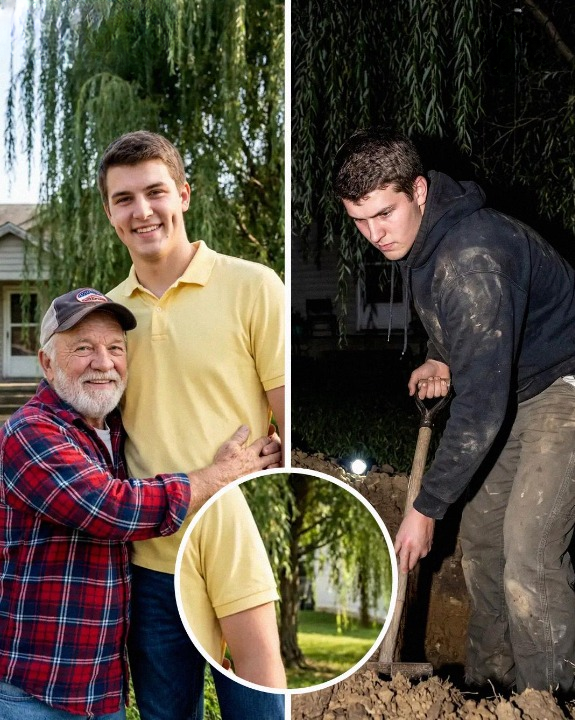
My grandfather raised me by himself after I lost my parents. When he died last week, I discovered a letter hidden beneath his toolbox that said, “Dig under the weeping willow in the backyard. There’s something I’ve kept from you for 22 years.” What I found there was only the start of a much larger secret.
My name is Nolan, and I’m 22 years old. For as long as I can remember, it was just Grandpa Earl and me living in an old farmhouse outside Cedar Hollow.
The floors creaked, the radio played softly in the kitchen every morning, and the smell of coffee seemed permanently soaked into the walls. We never had much money, but it was home—a place where every crack in the ceiling carried a memory, and every squeaky board felt welcoming.
My parents died in a car accident when I was three. Without hesitation, Grandpa gave up his peaceful retirement to raise me. He traded quiet days for sleepless nights, scraped knees, and school assignments. He never once complained.
My cousin Marla was already sixteen then. She only came around a couple of times a year, always rushed, always glancing at the clock. But the moment Grandpa passed last week, she appeared as though she had been waiting nearby the whole time.
At the funeral home, she shook hands and accepted condolences that felt meant for me. Later, after we buried Grandpa, she cornered me beside the coffee table back at the farmhouse.
“We should sell this place,” she said, stirring sugar into her coffee without meeting my eyes.
I stared at her. “What?”
“You’re young, Nolan. You’ll manage. But this house?” She looked around with disgust. “It’s falling apart. Winter’s almost here. You can’t handle it alone.”
I wanted to snap, but I stayed calm.
Then she asked, “Did Grandpa leave a will? Where did he keep important papers?”
“The funeral just ended, Marla.”
She shrugged. “Exactly. No point wasting time.”
That was when I understood—she hadn’t come to mourn. She had come to claim whatever she could.
I watched her search through drawers, cabinets, and shelves. She even picked up Grandpa’s pocket watch from the mantel, inspected it, and set it back down.
“I’ll be back tomorrow,” she said before leaving. “We can sort through his things and see what’s worth keeping.”
As if his whole life could be reduced to piles of junk and valuables.
That night, after everyone left, I was alone in the farmhouse. The silence felt unnatural. Grandpa’s chair sat empty by the window, his glasses folded neatly on the armrest. I couldn’t move them.
I wandered through the rooms, touching familiar things—the kitchen counter worn smooth with years of use, the toolbox he kept in the shed.
That’s when I noticed a yellowed envelope taped beneath the toolbox lid. My name was written across it in Grandpa’s shaky handwriting.
Inside was a note:
“My dear Nolan, dig beneath the weeping willow in the backyard. There’s a private matter I’ve hidden from you for 22 years. It’s time you learned the truth.”
The willow tree stood at the far edge of the yard, old and twisted. I grabbed Grandpa’s shovel and headed outside. The cold night air bit at my face as I dug into the earth. Minutes later, the shovel struck metal.
I dropped to my knees and uncovered a rusted safe buried beneath the roots. Just as I dragged it free, I heard a car door slam behind me.
Marla stood there, coat hanging open, eyes fixed on the box.
“What did he leave, Nolan? I forgot my purse… then I heard digging.”
I ignored her and opened the safe. Inside was a small pile of cash, one folded letter, and another sealed envelope marked:
“Only open if you choose to stay. If you choose the money, leave this sealed.”
I unfolded the first letter.
“Nolan, if you’re reading this, Marla has already shown up. I know her. She’ll pressure you to sell the house and take the easy road. This safe isn’t about what’s inside. It’s about what you do when someone tries to take something from you. Will you give in, or stand your ground?”
I slowly looked up. Marla was watching closely.
“What does it say?” she demanded.
“It’s private.”
Her tone hardened instantly. “So, have you decided about selling?”
“I need time.”
“Time?” she scoffed. “Time won’t save a sinking ship.”
She followed me back into the house, still talking.
“This is your chance, Nolan. You’ve always struggled. Sell the place, split the money, and finally have something stable.”
As she spoke, old memories surfaced. Marla had always wanted whatever belonged to someone else. Even when we were younger, she looked at things like prizes to be claimed.
She’d visit during holidays with expensive gifts, trying to impress Grandpa. But he always saw through it.
One Thanksgiving, she gave him a fancy watch. He thanked her and put it on a shelf, never wearing it once.
I once asked why.
He said, “Things mean nothing if the person giving them doesn’t understand why you’d want them.”
At the time, I didn’t understand. Watching Marla now, I finally did.
“Grandpa loved you too,” I said quietly.
She laughed bitterly. “He loved you more. Everyone knew it. You were always the favorite.”
“That’s not true.”
“I tried, Nolan. I tried so hard. But it was always you.”
For a second, I almost pitied her.
Then she announced she was taking my room for the night and I could sleep on the couch.
Instead, I spent the night walking through the house—the doorframe Grandpa repaired when I was eleven, the cabinet he taught me to sand, the porch railing we replaced together last summer. Every inch held a memory.
By morning, I knew my answer.
Marla stood in the kitchen pouring coffee when I said, “I’m not selling.”
She froze. “Excuse me?”
“I’m keeping the farmhouse.”
Her face reddened. “You’re making a terrible mistake.”
“Maybe. But it’s my mistake to make.”
She slammed the mug down, grabbed the safe from the counter, and in her anger dropped it. The second envelope fell out. She ignored it, snatched the cash, and shoved it into her purse.
“This should have been mine,” she hissed. “I should’ve been Grandpa’s favorite.”
I didn’t stop her. She was leaving with the smallest part of what he had left me.
She stormed out, warning I’d regret it.
Once she was gone, I opened the second envelope.
“If you chose to stay, then good. That means I taught you well. Look around you. At the memories. I’m always here. Everywhere. Even in the mirror. —Grandpa”
I read the words again and again. Even in the mirror.
I went to Grandpa’s room and stood before the tall mirror near the closet. Nothing unusual. Then I tapped the wall behind it. Hollow.
I slid the mirror aside. Hidden behind it was a small keyhole, with a brass key hanging beside it.
My hands shook as I turned the key. A compartment opened, revealing another metal box.
Inside was more money than I had ever seen—bundles of bills stacked neatly. Beneath them lay one final letter.
“Dear Nolan, I’ve been saving this since the day you were born. Every spare dollar I could. I always meant for you to have it, but only when you were ready.
Last year the doctors told me I might not have much time left, so I knew I couldn’t wait. But I needed to know you’d find this the right way—that you’d understand the value of holding on to what matters.
Use it wisely. Build something worthwhile. I’m proud of you, son. Always have been. Love, Grandpa.”
That was when the tears came.
Even in old age, even while sick, Grandpa had still been thinking about me.
I sat on the floor clutching the letter while the house creaked around me, warm and familiar. For the first time since he died, I felt he was still there—in the walls, in the lessons, in every corner of the home we shared.
Days later, I began restoring the farmhouse. I repaired the porch, replaced the broken kitchen window, and painted the shutters. Every hammer strike felt like a conversation with Grandpa. Every repair proved I could stand on my own.
I wasn’t just saving the house—I was honoring the man who raised me.
One afternoon, I stood beneath the weeping willow again, this time to plant a young oak tree.
As I pressed the soil down around it, I realized Grandpa hadn’t just left me money or answers.
He had made sure I could stand on my own when it mattered most.
And that is the greatest gift anyone can leave behind.