
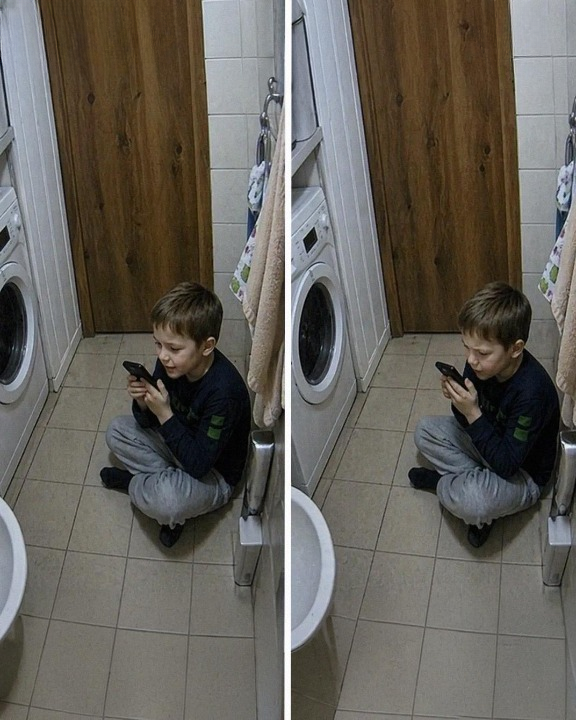
My son phoned me around noon from the bathroom, whispering that a woman in our living room was claiming to be his “real mother.” My husband wasn’t answering his phone, and by the time I reached our driveway, fear had already taken hold—though nothing could have prepared me for what I was about to see.
I barely remember shutting down my office computer before rushing out. All I could hear was Jonathan’s shaky voice repeating, “Mommy, the woman in the living room says she’s my real mom.” It sent a chill straight through me.
During the drive, I tried to make sense of it. Maybe he misunderstood. Maybe Leo had brought someone home who made a terrible joke. But no explanation felt right. I kept calling Leo—at every red light, every turn—but he never picked up.
The morning had been completely normal. I’d said goodbye to both of them, and Jonathan had been excited to spend the day with his dad. Leo didn’t take time off often. He also traveled a lot—maybe more than he should. I’d never had concrete reasons to doubt anything, but with my son hiding in a bathroom, my thoughts started drifting to things I might have ignored.
Still, none of that explained why a stranger would tell my child she was his mother. By the time I pulled in, I was bracing for everything to fall apart.
I ran inside and called for Jonathan. The house felt unnervingly quiet. Then the bathroom door upstairs flew open, and he came running to me in tears. I dropped to my knees as he threw himself into my arms, clinging tightly. He pointed toward the living room with a trembling hand.
There, sitting on the floor, was a woman—soaked, dirty, her hair tangled. She stared at Jonathan with an intensity that made my skin crawl. Leo stood nearby, tense and helpless. When he saw me, his face showed both relief and fear.
Before he could explain, the woman spoke. Her voice was fragile from crying. “My name is Reese. That’s my son.”
Panic surged through me. I demanded answers from Leo, but he hesitated. He admitted he had brought her home after finding her outside, drenched and distressed, clutching a doll and insisting she needed to get to her son. He hadn’t felt right leaving her there.
On the drive back, she’d spoken gently to Jonathan, but once inside, everything changed. Leo had stepped away briefly, and when he returned, she was holding Jonathan’s hand and telling him she was his real mother. Jonathan had run upstairs with Leo’s phone and called me.
The woman—Reese—kept insisting my son belonged to her. Her confusion made her frightening. I told her to leave and warned I would call emergency services. Just then, there was a knock at the door.
A police officer entered and immediately recognized her. Relief washed over him as he approached. “We’ve been looking for her,” he said. Reese called him Kyle and insisted again that Jonathan was her son. He gently tried to calm her and lead her out, apologizing to us.
An ambulance waited outside. What had felt like a threat began to look like a crisis. The officer explained briefly that she had wandered off and that they had been searching for her.
That night, Jonathan slept between us. Leo and I lay awake in silence. I told him he should never have brought her home. He agreed without arguing.
The next morning, we went to the hospital for answers. The officer met us there and told us the truth. Years ago, he and Reese had lost their baby boy during delivery. She had never fully recovered. Most days she was fine, but sometimes seeing a child the age her son would have been triggered something in her mind. In those moments, she truly believed the child was hers.
The explanation didn’t erase the fear—but it reshaped it into something heavier, sadder.
We were allowed to see Reese. She was calm, composed, and deeply ashamed. She apologized over and over, explaining that during those episodes, what she sees feels real, even if it isn’t. When clarity returns, she’s left to face the damage.
I told her she had frightened my son—and me—but I also told her I was sorry for what she had endured. Before we left, she asked me to tell Jonathan she was sorry.
Later, when we picked him up, he asked if she was really his mother. I reassured him gently that she wasn’t, and explained that she was someone who was hurt and confused and needed help. He accepted that in the simple, honest way children do.
That day didn’t make anything easier, but it changed something in me. It reminded me that being a mother isn’t just about giving life—it’s about showing up when your child calls for you.