
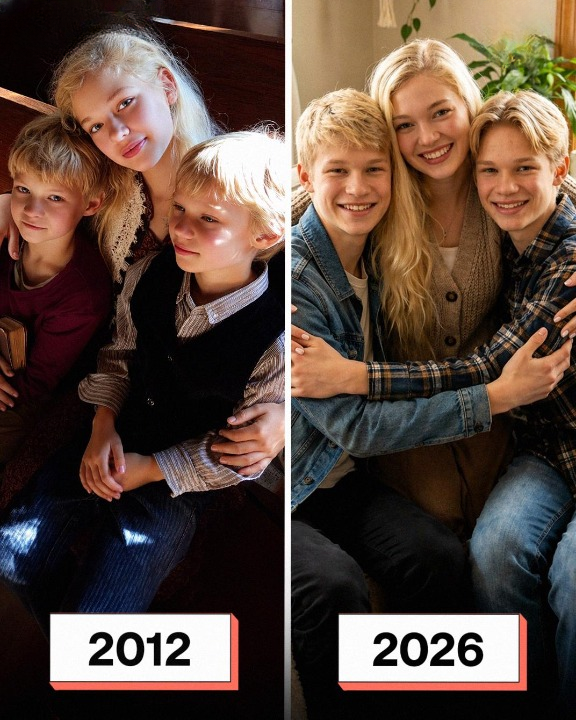
I was 13 when my parents left me sitting in a church pew with my three-year-old twin brothers and told me, “God will take care of you.” Fourteen years later, they showed up at my door looking polished, successful, and as if nothing had ever happened—asking for my brothers back like they’d only stepped out for a moment.
Three nights ago, I was in my kitchen holding a framed photo of Cody, Brian, and me at a county fair, all of us laughing like life had always been gentle. On quiet nights, it still feels like I could walk back into that church and see it all happen again—my mother smoothing Cody’s hair, telling me to stay put, promising divine protection. My father didn’t say a word. He just left with her, as if abandoning three children was something ordinary.
That night, a nun found us. Then social services came. After months of instability, a woman named Evelyn took us in. She didn’t have much, but she gave us a home and stayed when no one else did. When I was 17, she passed away, leaving everything she had to us.
From then on, I became the one responsible for my brothers. I worked long shifts, pushed through exhaustion, and built our life one day at a time. Cody and Brian grew up beside me, and I did everything I could to make sure they still had a future worth choosing.
Years later, when I was thinking about that life we built, the knock at the door brought the past crashing back. Standing there were my parents—older, dressed well, and pretending none of it had ever broken.
My father greeted me casually, as if we were catching up after a normal separation. My mother spoke gently, almost rehearsed, complimenting how I had “taken care of the boys.” Then my father said something that made my stomach drop: they had come to take Cody and Brian back.
They acted as if they were entitled to resume their roles after 14 years. As if absence could simply be reversed.
I told them they couldn’t just take my brothers. So I agreed to let Cody and Brian meet them—on my terms, the next day at a park.
Before I even told the boys, I knew the choice couldn’t be mine alone. They were old enough to decide for themselves. I didn’t want to control them with fear or loyalty.
The next day, I told them everything. Their reaction was quiet at first—confusion, then disbelief. When we reached the park, our parents were already waiting, trying to present themselves as a ready-made family.
I stepped aside and let my brothers talk to them alone.
What followed was something I’ll never forget.
My father spoke about “a better life” and how this could benefit everyone. But the more he talked, the clearer it became that it wasn’t about love—it was about image, control, and convenience.
Brian finally spoke up, pointing out the truth: they weren’t wanted as children, only as symbols to fix their reputation. Cody didn’t hesitate either, reminding them that I had been the one who stayed when they walked away.
One by one, the illusion fell apart.
Then both of my brothers turned away from them and walked back to me.
No hesitation. No debate.
They chose the life we had built together.
My father called it a mistake. My mother tried to justify the past. But the truth didn’t change: they had left us once, and we had survived without them.
We went home together that day—just the three of us, like we always had been.
And for the first time in a long time, I understood something clearly: family isn’t defined by who returns when it’s convenient. It’s defined by who never left in the first place.