
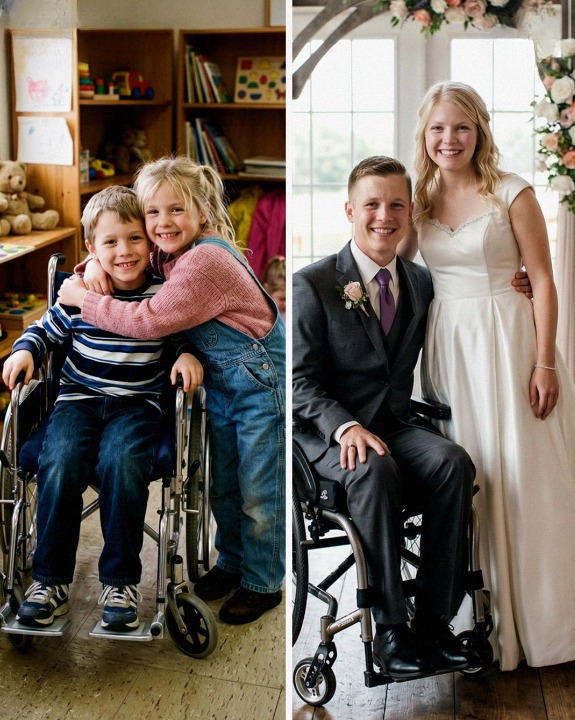
I married the boy I grew up with in an orphanage, and the morning after our wedding, a stranger came to our door and said something about my husband that changed everything I thought I knew.
I’m Claire, 28. I grew up in the foster system, moving from home to home until it all started to blur together. By the time I was a kid, I’d already learned the same lesson over and over: don’t get attached, because people leave.
Eventually, I ended up in an orphanage where I met Noah.
He was nine, quiet, and in a wheelchair. Not many kids knew how to treat him, so most of them either ignored him or acted like he wasn’t really part of things. Adults weren’t much better.
I remember sitting near a window one afternoon and saying something simple like, “If you’re going to sit there, you have to share the view.”
That was how it started.
Noah and I became each other’s constant. We grew up side by side in a place where people came and went, and we stopped expecting anyone to choose us.
We joked about it, saying things like, “If you get adopted, I want your hoodie.” But underneath it was something real—we were all we had.
Years passed, and we aged out of the system together at 18. No celebration, no family, just a few bags of belongings and a bus pass.
We left together.
Life after that wasn’t easy. We shared a tiny apartment above a laundromat, worked any job we could find, and slowly built a life from nothing. Somewhere along the way, friendship turned into something deeper without either of us really naming it.
Eventually, we got married.
It was small, simple, and perfect in its own way. No big crowd, just the life we’d managed to build together.
We thought that was the beginning of our “finally safe” chapter.
Then, the morning after the wedding, someone knocked on our door.
It was a man in a dark coat—calm, serious, the kind of person who doesn’t show up without a reason.
He asked for Noah.
Then he said something that made my stomach drop:
There was something I didn’t know about my husband.
He introduced himself as an attorney and said he was there because of a man named Harold Peters. He handed us an envelope and asked us to read it.
Noah opened it slowly.
The letter inside was written to him.
It said Harold had known Noah years ago, briefly, and remembered something he had done—something Noah himself barely recalled: a small act of kindness toward a stranger who had fallen and been ignored by everyone else.
That stranger had been Harold.
He explained that he had never forgotten that moment, because Noah was the only person who stopped, helped, and treated him like a human being when no one else did.
And now, Harold had died.
But before he did, he left everything he had—his house, his savings, his assets—in Noah’s name.
Not because Noah asked for anything.
But because, years ago, he had given something simple away without expecting anything back: kindness.
We sat there in silence, trying to process it.
Because what the lawyer was telling us wasn’t just about money or a house.
It was about how one forgotten moment of decency had come back years later and rewritten everything.
And just like that, our life didn’t feel like it was starting after the wedding anymore.
It felt like it had been waiting for this moment all along.