
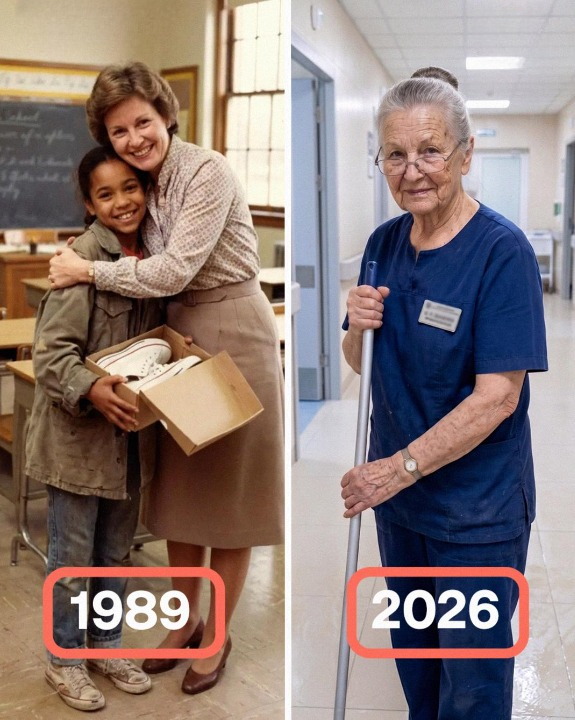
I was stunned when I realized the woman who once bought me a pair of shoes was now working as a janitor. She didn’t recognize me at all, but I never forgot her. After 37 years, I returned with something I had kept all that time—and when she saw it, her expression completely changed.
“Why would you do this to me?” she whispered in disbelief.
I leaned in and told her the truth I had carried for decades—something that brought her to tears.
When I was 11, my father passed away and left us drowning in debt. My mother and I lived in constant uncertainty, never sure if we could cover rent, food, or electricity.
Most of my clothes came from thrift stores or clearance racks. Then my shoes started falling apart. At first it was just worn soles, but eventually there were holes right through them. I didn’t tell my mom—I didn’t want to add to her burden.
I could endure the wet socks on rainy days, but I couldn’t escape the cruelty at school.
“Ew, I can see her sock through her shoe,” one girl said loudly one day.
Another laughed. “Her sole is literally coming off.”
I kept my head down and tried to ignore it.
At lunch, they mocked me again across the room.
“Maybe it’s vintage,” one joked.
“Yeah, ‘vintage’ means broken on purpose,” another replied.
I remember sitting there, trying not to cry, focusing on anything but their voices.
But it didn’t stop there.
They started imitating the sound my shoes made when I walked.
“Flap, flap, flap,” they mocked.
Then came the worst question: “Are you too poor to get new shoes?”
That day, I broke down quietly in the back of the classroom, hiding my face behind a book, hoping no one would notice.
But someone did.
A few days later, my teacher, Mrs. Price, called me aside after class. My heart sank—I thought I was in trouble.
Instead, she handed me a shoebox.
“I noticed your shoes were getting worn,” she said gently. “I thought you might like these.”
Inside were brand-new sneakers.
I couldn’t stop myself—I hugged her, crying into her sweater while she held me and told me I never had to feel ashamed like that again.
Those shoes changed everything. I stopped hiding. I started participating again. Slowly, I became myself again.
Years later, I found her again—working a difficult job, struggling quietly in ways I hadn’t known.
That night, I couldn’t sleep. I found the old shoebox I had kept all those years. The shoes were still inside.
And in the morning, I went to see her.
When I gave her the box and showed her what I had preserved for 37 years, she was speechless.
Then she saw something else inside—a letter I wrote as a child but never finished.
Her eyes filled with tears as she read it.
I told her I had become the kind of person she once inspired me to be—the kind who helps before being asked.
And then I told her the part that made her cry even harder:
that now it was my turn to help her.