
I always thought some things in life were untouchable—especially those rooted in family history and time. I never imagined I’d come home and learn just how wrong I was.
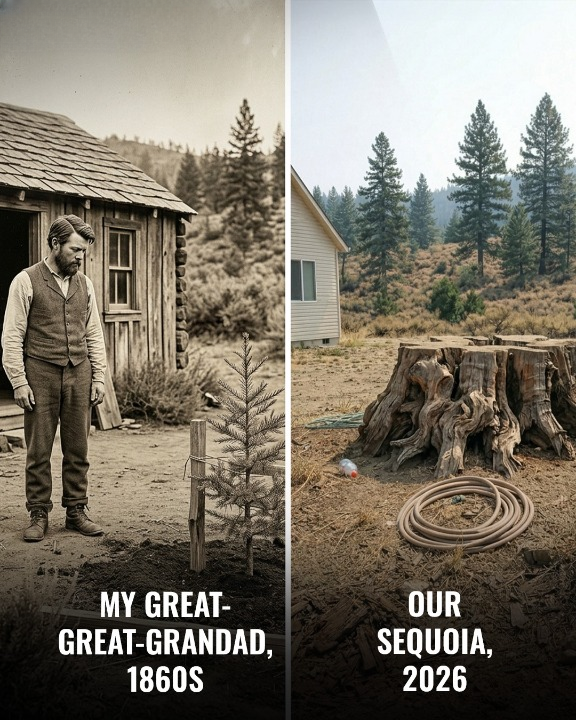
My name is Samantha, and I grew up believing the 200-year-old sequoia in our yard would outlive all of us.
It was planted by my great-great-grandfather, Simon, shortly after he immigrated to America. Family stories said he had almost nothing—just a small piece of land and the belief that if he planted something deep enough, it would endure. And it did.
That tree became living proof of his legacy.
Every generation in my family took photos beside it—weddings, birthdays, ordinary afternoons. It wasn’t just a tree to us; it was a symbol of survival, continuity, and resilience through hardship.
To our neighbor Roger, however, it was an ongoing annoyance.
For years, he complained about it constantly.
He claimed the roots were invading his yard, that insects were ruining his garden because of it, and even that it blocked his sunlight. At one point, he shouted over the fence about not getting his “vitamin D” because of our tree.
I tried to be reasonable. We even paid for professional trimming on his side of the property, hoping it would ease tensions. But instead of calming down, Roger became more hostile, eventually demanding we cut the entire tree down because it “ruined the neighborhood’s appearance.”
We refused.
So we ignored him and carried on with our lives—until we went on vacation.
We were gone for a week, just a simple family trip. But when we returned, something immediately felt wrong.
The yard looked empty.
And then I saw it—the sequoia was completely gone.
Not trimmed. Not damaged. Erased.
Only a jagged stump remained, surrounded by sawdust and heavy tire tracks from machinery. My daughters were stunned. One of them asked where the tree was, but I had no answer.
Then Roger appeared in our yard, almost casually, as if he had been waiting.
He looked satisfied.
And in his hand was a polished wooden cane in the exact reddish color of our tree.
When I asked what he had done, he denied responsibility while implying we had brought it on ourselves. It was clear he believed he had won—but I had no proof, only suspicion.
That night, I couldn’t sleep. But eventually, I formed a plan.
The next day, I went to Roger’s house with a framed “gift,” pretending to make peace. Inside, I found exactly what I suspected—his home filled with brand-new wooden furniture and decor that matched the same grain and color of our fallen sequoia.
I didn’t say anything right away. Instead, I gave him the frame.
Inside was a collage of generations of my family standing beside that tree, along with an engraved message: “Before it was yours.”
The frame itself contained wood taken from the remaining stump.
Roger realized what I had done, but I calmly told him it was just a reminder of where everything had come from. I left shortly after, knowing I didn’t need his admission—only his reaction.
Then I shared the story with neighbors. Not accusations, just history. Photos. Memories. The truth of what that tree meant to our family.
People began to piece things together on their own.
And slowly, Roger became the subject of quiet judgment around the neighborhood. He noticed it too. The confidence he once had began to fade.
Eventually, the neighborhood held a gathering centered on local history. I spoke about the sequoia, about my great-great-grandfather, and about what it means when something irreplaceable is lost. I never mentioned Roger—but I didn’t need to.
Everyone already understood.
The next day, Roger came to my door. No arrogance this time. Just discomfort and a partial acknowledgment that he may have gone too far.
I accepted it without argument.
Then I offered something unexpected: a chance to make things right.
We would plant a new tree together—not a giant sequoia, but a smaller species placed responsibly, with care for both properties.
That weekend, the whole neighborhood helped plant it.
Roger worked quietly beside us, no complaints, no excuses.
When he finally looked at the sapling, he asked if it would last.
I told him it would—if we let it.
And for the first time since everything happened, it didn’t feel like something had been destroyed.
It felt like something new had finally begun.