
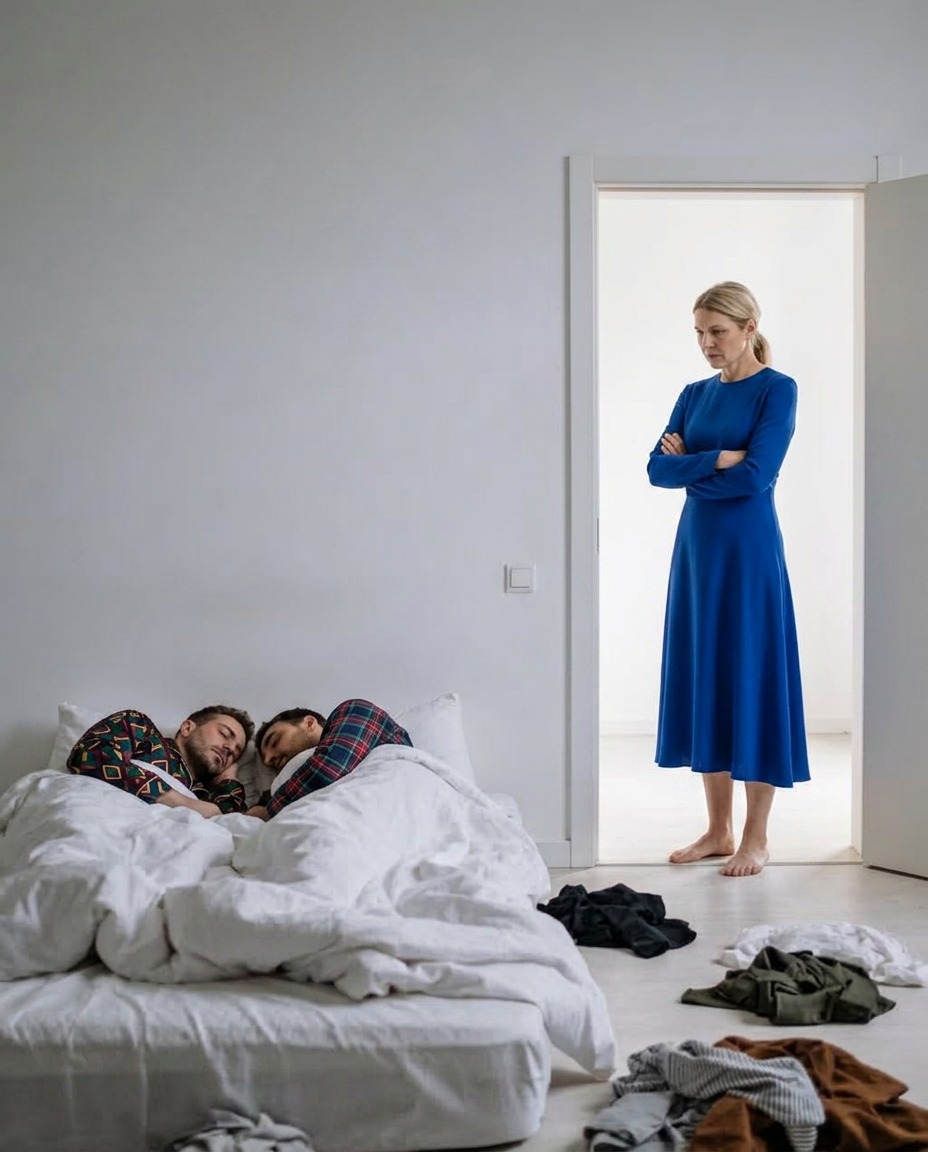
Around 11 a.m., Clara arrived home after a four-month work trip. She hadn’t told her husband or son she was coming—she wanted to surprise them. Her bag was filled with groceries and their favorite ingredients, already imagining a warm meal like the ones she used to make.
But as she approached the building, she noticed something was off. It was strangely silent—no TV, no music, no voices at all.
She knocked. Once. Then again, louder.
Still no response.
Frowning, she tried again, calling out to them. When nothing changed, she searched for her spare key. It took her a moment, but she eventually found it and let herself in.
Inside, everything was spotless. Too neat. Not the kind of home she expected after months away.
She set the groceries down slowly.
Then she saw them—women’s shoes by the wall.
Not hers.
Her chest tightened. For a moment, she tried to rationalize it, to make it something harmless. But the feeling didn’t last.
She moved deeper into the house, her steps slow and uneasy. The bedroom door was slightly open.
“Who’s there?” she called.
Silence answered her.
The air inside felt heavy. She edged closer, shaking now, and reached for the bed. After a brief hesitation, she pulled the sheet back.
A strand of long dark hair lay there.
Not hers.
Her body went still. Everything inside her seemed to lock up at once—shock, disbelief, and something sharper underneath.
Without thinking, she backed away, her breathing uneven. No shouting came, just a suffocating quiet that felt worse.
She left the room and noticed a broom leaning against the wall. Gripping it tightly, she turned back toward the bedroom, her thoughts spiraling with questions she couldn’t yet form.
But before she could step inside again, a voice stopped her.
“Clara?”
She turned.
Her husband stood in the hallway, just coming out of their son’s room, disheveled and confused. It only took him a moment to understand the scene: Clara holding the broom, the open bedroom door, the tension in the air.
“Clara, wait!” he said, moving toward her.
“Let me go!” she snapped, struggling as he caught her arm.
“Please, just listen!”
“Listen to what?”
He called out, “Mateo!”
Their son appeared, still half asleep and disoriented.
And behind him stood a young woman.
Clara’s grip loosened slightly, but her expression stayed tight with emotion.
“Mom…” Mateo said quietly.
A heavy silence followed as Clara lowered the broom. Her husband slowly let go of her arm.
“Let’s sit down,” he said.
They moved into the living room.
Clara sat rigid, staring ahead. Mateo and the girl sat close together, while her husband remained tense beside them.
Finally, Clara broke the silence.
“Start from the beginning. Who is she?”
Mateo swallowed hard.
“She’s my girlfriend.”
Then, after a pause—
“She’s pregnant.”
The words settled heavily in the room.
“How far along?” Clara asked quietly.
“Two months.”
She leaned back, absorbing it.
Then she looked at her husband.
“You knew?”
He nodded. “For a month.”
Clara let out a short, disbelieving laugh.
“And she’s been living here all this time?”
“We were going to tell you… we just didn’t know how,” he said quickly.
Mateo and his girlfriend explained—hesitantly, imperfectly. Limited space, temporary arrangements, decisions made too fast.
The girl finally spoke, voice trembling. “I’m sorry… I didn’t mean to cause trouble.”
Clara studied her for a long moment. Not an intruder—but someone young, anxious, and overwhelmed.
“What’s your name?” she asked.
“Lucía.”
Silence followed as everything settled into place. Not betrayal, not deception as Clara first imagined—just confusion, poor timing, and badly handled choices.
Finally, Clara exhaled.
“This was done very poorly,” she said.
They all agreed.
“But it’s done,” she added. “So now we deal with it.”
Apologies were exchanged, awkward but sincere.
Then, after a pause, Clara stood.
“Well,” she said, “I brought food. We’re going to eat it.”
It didn’t fix everything—but it softened the air.
In the days that followed, things were uneasy at first. But slowly, small changes appeared: shared meals, hesitant conversations, moments of understanding.
Clara softened over time. She accompanied Lucía to appointments, guided Mateo when needed, and quietly left small comforts around the house.
Eventually, as the baby’s arrival approached, Clara and her husband helped the young couple move into a small apartment of their own.
Lucía cried. Mateo struggled for words.
Clara simply said, “It’s so you can start properly.”
Three years later, the house felt different—livelier, warmer.
There was laughter again, footsteps in the halls, and eventually a wedding.
It wasn’t perfect, but it was real.
Clara watched quietly as life unfolded around her, giving a small nod when Mateo looked her way.
Because life didn’t return to what it had been.
It became something new.
And sometimes, that was enough.