
When people talk about success, they usually point to visible things—degrees on the wall, job titles, achievements that earn applause. But what often goes unseen is everything that makes those accomplishments possible: the quiet, exhausting sacrifices of the people who support us from the background.
This is for my sister—the one who raised me.
There are moments in life that only make sense in hindsight. For me, that moment was when my younger sister stopped being just a sibling and became my caretaker. She left college without fanfare, took on multiple jobs, and somehow stretched every dollar to keep us afloat. She hid her exhaustion well, always reassuring me that things would be fine, and I believed her because I didn’t know what else to believe.
She didn’t choose that life out of desire, but necessity. At the time, I didn’t fully understand what she was carrying. I was focused on my own education, my own future, my own ambitions. I was doing well—moving through school, internships, and eventually into a career that looked successful from the outside.
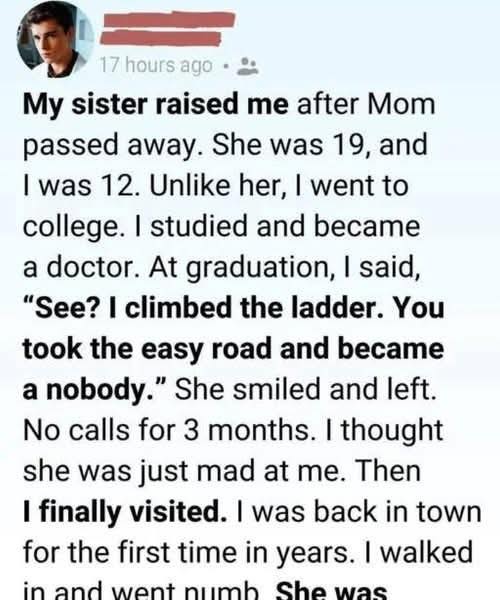
When I graduated, I was proud. I looked for her in the crowd and found her in the back, clapping softly, her face full of quiet pride. In that moment, I let my arrogance speak. I told her I had “made it,” that I had climbed up, while she had taken the “easier path” and ended up with nothing.
She didn’t argue. She just smiled and said she was proud of me. Then she walked away, and I told myself that was simply how life worked.
Months later, I visited her unexpectedly during a work trip. Her home felt wrong—quiet in a way that suggested something had been drained from it. I found her collapsed, weak, barely able to move. In the hospital, I learned the truth piece by piece, each detail heavier than the last.
She had been living with a serious chronic illness. She had missed treatments and medication because she couldn’t afford them. All those years, she had been choosing between her health and my future—and she always chose me.
Then came the truth that shattered everything I believed. There was no inheritance from our parents. No safety net. Every dollar I had for school, rent, and living expenses had come from her—earned through relentless work, sleepless nights, and sacrifices she never spoke about. She even sold personal and sentimental belongings from our childhood to keep me moving forward.
Everything I thought I had achieved independently was built on her silent endurance.
In that hospital room, my understanding of my life collapsed. I had been measuring success in milestones, while she had been paying for those milestones with her health, her comfort, and her future. I realized I had mistaken her silence for simplicity, and her sacrifice for something ordinary.
When she woke, she still smiled at me gently, as if nothing had changed. But everything had changed for me. I finally understood that true strength is often invisible. It doesn’t announce itself. It exists in the background, holding everything together while others move forward.
Her love wasn’t loud, but it was foundational. It gave me every chance I had. And only then did I realize that success isn’t just about what you build for yourself—it’s also about recognizing who built the ground beneath you.
This isn’t only about my sister. It’s about how easily we overlook the people who support us the most. We assume they are fine because they never complain. We assume they are strong because they never stop giving. But strength has limits, even when it’s hidden behind a smile.
Pride can blind us to the truth. It can make us confuse achievement with worth and visibility with importance. I learned too late that I had done exactly that.
Gratitude, I realized, should never come after understanding—it should come before regret.
In the end, I learned that real greatness is not measured by recognition or applause, but by the quiet acts of care no one sees. My sister’s life was not defined by titles or awards, but by everything she gave up so that I could have a chance to build my own.
And now I understand: success is not just standing on a stage alone. It is knowing who stood behind you when you couldn’t stand yet—and making sure you never forget it.