
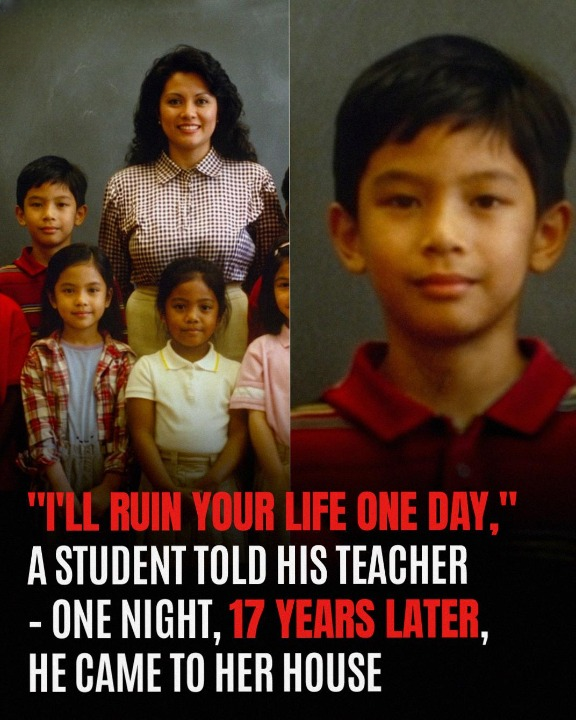
Seventeen years ago, a student stood in my classroom shaking with anger and swore he would ruin my life. I thought I had left that moment in the past—until one night he showed up at my door.
Even now, I can still hear his voice.
“I’ll ruin your life one day!”
Back then, he was Daniel—a troubled teenager barely holding himself together. He was frustrated, defensive, and convinced I didn’t understand him. I tried to calm him down, but it only made things worse.
“Sit down, Daniel,” I told him. “You’re not thinking clearly.”
“I am thinking clearly!” he shouted, the chair scraping behind him as the whole class went silent.
“You think you control everything! You think you know what’s best for me!”
“I’m trying to help you,” I said more gently.
But he didn’t want help.
“I don’t need your help!” he snapped. Then, before storming out, he threw the words at me that stayed long after he left:
“I’ll ruin your life one day. You’ll see.”
I dismissed him that day. Told him to leave. And then he disappeared from my life completely.
Years passed. I retired. Life became quiet—almost too quiet. No classrooms, no students, just time and memory I couldn’t seem to shake.
Especially his words.
Then, one night at 2 a.m., someone knocked on my door.
BANG. BANG. BANG.
My heart jumped.
When I opened it, a man stood there. Polished, older, dressed in a police uniform.
And his eyes…
I knew them instantly.
“Do you remember me?” he asked calmly.
My voice barely worked. “Daniel?”
“Yes,” he said.
Seventeen years vanished in an instant, replaced by fear I didn’t expect to still feel.
“You were right to remember,” he said when I asked why he was there.
His presence felt unsettling, and when he reached into his bag, I instinctively stepped back.
But he didn’t pull out anything dangerous.
Instead, he handed me an old notebook.
Something about it felt familiar.
Then I saw it—my own writing inside.
One sentence I had written years ago when I confiscated it from him:
“You are not what your anger says you are. But if you don’t learn to control it, it will decide your future for you.”
My breath caught.
“I kept it,” he said quietly. “Because it was the first time anyone ever saw me instead of judging me.”
Everything shifted in that moment.
He wasn’t there for revenge.
He was there because that one sentence had followed him through his darkest years—pulling him back every time he was close to falling apart.
“I meant what I said,” he admitted. “I said I’d ruin your life.”
I stiffened.
“But not in the way you thought,” he added.
Then he told me the truth: that he had struggled for years, almost lost himself completely, but kept coming back to those words. Not the anger—but the possibility that someone believed he could be more.
“You were the only one who didn’t give up on me,” he said.
My eyes filled with tears.
“I thought I failed you,” I whispered.
He shook his head. “No. You saved me.”
Then he handed me an envelope. Inside was an official letter recognizing me for changing the life of a police officer.
I couldn’t speak.
All those years, I thought I had lost him to anger.
But instead, something I said had stayed with him long enough to change everything.
And I was left with one question I still think about:
Can a single moment of belief in someone change the entire direction of their life—even when you never know it happened?