
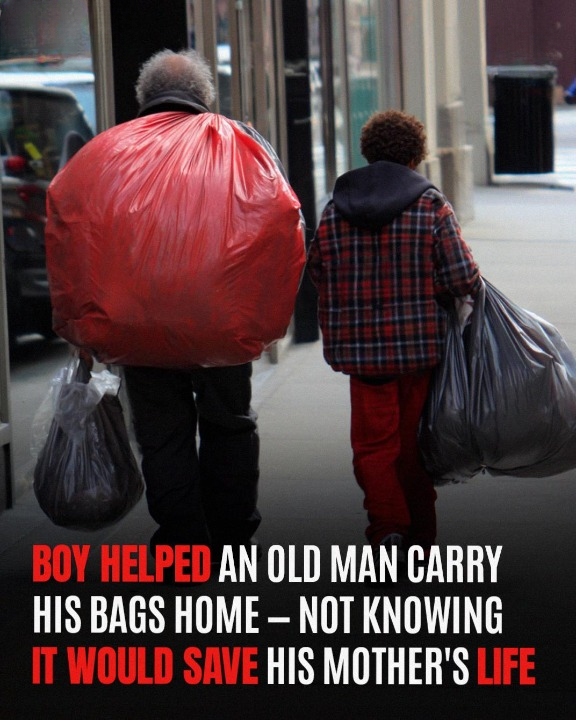
I was just twelve when I chose to help a stranger everyone else ignored. He looked like someone life had already given up on—weak, alone, and barely noticed by those passing by. I didn’t know his name, and I never expected anything in return. But that single moment would later become the reason my mother survived.
My name is Daniel, and I learned early that even the smallest decision can echo back in ways you could never imagine.
That afternoon felt ordinary at first. The sun was sinking low, casting warm light over the street as I walked home from school with my backpack weighing heavily on my shoulders. But my thoughts weren’t on school—they were on my mother.
“She looked worse this morning,” I thought quietly, remembering how she forced a smile for me despite clearly struggling.
She always tried to hide it.
“Go on, Daniel,” she had said gently. “Don’t be late.”
But I noticed the trembling in her hands. I noticed the pain she tried to disguise. And I felt helpless because I didn’t know how to fix it.
Suddenly, noise broke my thoughts. A small crowd had gathered nearby—people pointing, whispering, even laughing.
Curious, I moved closer.
And then I saw him.
An elderly man lay on the ground, thin and exhausted, with two worn bags beside him. He tried to push himself up, but his body wouldn’t obey. Instead of helping, people mocked him.
“Careful, old man,” someone joked. “Those bags too heavy for you?”
Laughter followed.
My chest tightened.
“No one’s helping him?” I muttered.
No one responded.
He tried again to stand and collapsed back down. That was it for me. I stepped forward immediately.
“Sir, are you okay?” I asked, kneeling beside him.
“I’m fine,” he insisted weakly. “Just leave me.”
But I couldn’t.
I lifted one of his bags and nearly dropped it—it was heavier than I expected. Still, I stayed.
“My name is Daniel,” I said. “I’m not leaving you here.”
After a long pause, he finally nodded.
“Then help me home,” he said.
That was how it began.
The walk was slow. He leaned on me heavily, breathing unevenly, stopping often to catch his strength.
“You don’t have to do this,” he said quietly. “You’re just a boy.”
“Then you’re just an old man who needs help,” I replied.
Something softened in his expression.
We walked in silence until we reached a small, worn trailer on the edge of a lot. It didn’t look like much of a home.
Inside, it was dim and quiet, filled with papers and careful stacks of documents. I set the bag down and turned to leave.
“Wait,” he said.
I stopped.
He opened the bag—and everything changed.
Inside were neatly organized files, medical documents, and a thick envelope of money. I froze.
Then he showed me an old photograph.
A younger version of him stood beside a woman I immediately recognized.
My mother.
“That’s her,” I said breathlessly.
He confirmed it gently. “I’ve been looking for her.”
Confusion hit me. “Why?”
He explained that years ago, he had been wealthy but sick and alone. The only person who truly cared for him wasn’t his family—it was a cleaner named Grace.
My mother.
“She treated me like a person,” he said. “Not my money. Me.”
But she disappeared before he could ever thank her.
Then everything shifted again.
“She’s sick,” I told him suddenly. “Badly. We don’t have money for treatment.”
His expression changed instantly.
“Take me to her,” he said.
And without hesitation, he followed me home.
When my mother saw him, her face went pale with shock—and then relief.
They knew each other.
He promised her quietly, “Now it’s my turn to help you.”
What followed was a blur of doctors, hospital visits, and urgent decisions. But for the first time in a long time, I saw hope instead of fear.
Her condition was serious—but treatable.
And she survived.
All because I once chose to help a stranger carry his bags home.
A simple act I thought meant nothing… turned out to be the reason my mother got a second chance at life.