
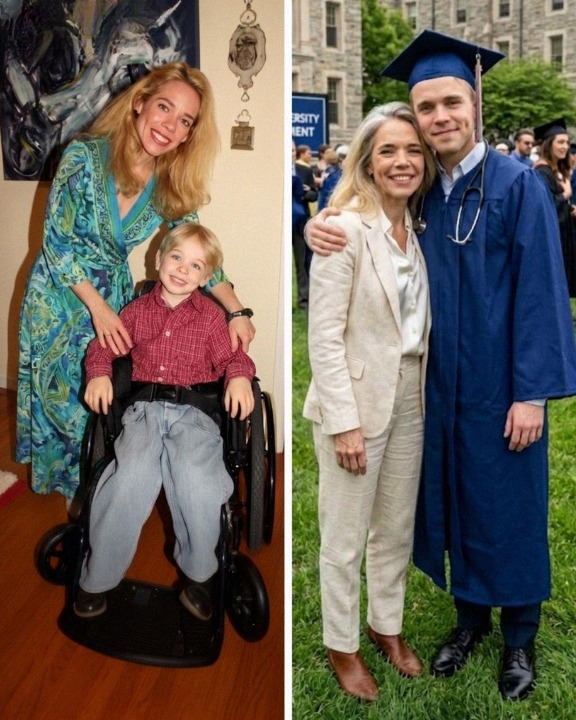
I went into motherhood believing my marriage could survive anything. I was wrong. The day our son was born, my husband walked away—and I spent the next 25 years raising our child on my own. Then, one moment in front of a crowd forced the man who left us to face everything he’d abandoned.
The day he left, there was no shouting, no slammed door—just silence.
Our son, Henry, was only hours old when a neurologist gently explained that he would face motor challenges and need ongoing care. I was still processing it when my husband, Warren, made his decision.
“I’m not doing this,” he said flatly.
No anger. No fear. Just rejection.
He walked out of that hospital room and never looked back.
So I stayed.
I brought Henry home alone, learned how to navigate therapies, appointments, and exhaustion without help. The years that followed weren’t heroic—they were difficult, messy, and relentless. I fought for him in classrooms, advocated for him in doctor’s offices, and reminded him, again and again, that he was capable.
And Henry rose to meet every challenge.
He grew into someone sharp, determined, and deeply compassionate—someone who refused to be defined by what others thought he couldn’t do. Eventually, he set his sights on medicine, driven by a simple goal: to treat people like people.
He achieved it.
Years later, on the verge of graduating medical school at the top of his class, Warren reappeared—drawn not by struggle, but by success. He said he was proud. He wanted to attend the ceremony.
Henry invited him.
At graduation, Warren showed up like he belonged, complimenting the son he had once abandoned, surprised by how “well” things had turned out.
Then Henry took the stage.
He spoke calmly, clearly, and without bitterness—but with truth.
People expected a story about perseverance, he said. But if he stood there that day, it wasn’t because he was extraordinary.
It was because his mother was.
He told them how his father had left the day he was born—and how his mother stayed through every hardship that followed. Every appointment. Every doubt. Every long night.
Then he made it unmistakably clear:
This moment didn’t belong to both parents.
It belonged to the one who never walked away.
The room erupted in applause.
Warren stood there, silent—finally seeing the life he had chosen to abandon, and the strength he had never understood.
Afterward, he tried to speak. But Henry stopped him.
“You don’t get to step back into the story now,” he said. “If you want to know how it ends—look at her.”
And just like that, the man who left us was left standing alone—while everything we built without him stood stronger than ever.