
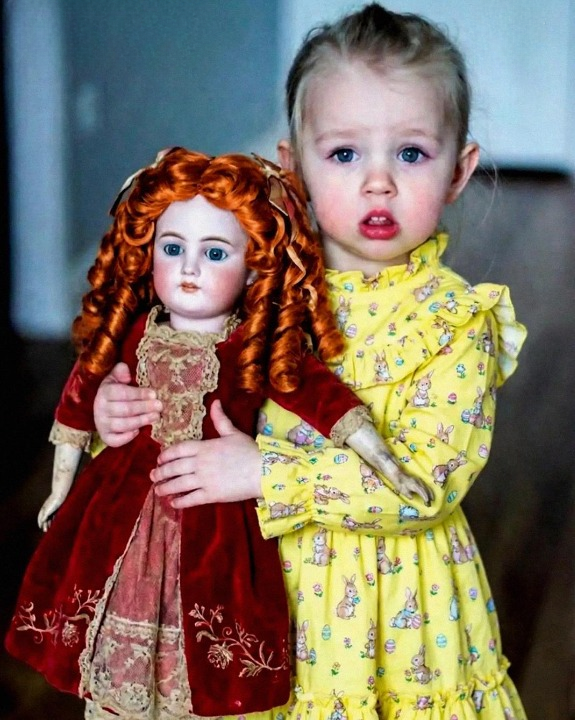
When a financially struggling single mother purchases a vintage doll at a flea market for her young daughter’s birthday, she never imagines it will carry a message from another life. What starts as a simple present slowly reveals a deep emotional link between two grieving families—and a love that continues to exist beyond loss.
My name is Pauline. I’m 34, a single mother, and I’ve spent most of my adult life working as a janitor. My daughter Eve is six years old.
She’s an exceptionally kind, patient, and loving child—far more than I feel I deserve. She’s everything good in my world.
Since her father died of cancer three years ago, our lives fell apart. I tried to hold us together, even when I felt like I was breaking inside. Since then, it has just been the two of us, trying to survive and rebuild something resembling normal life.
Eve’s birthday was approaching, and I wanted to give her something meaningful—something that would make her feel special, even just for a day. But the reality of bills, rent, and daily expenses made that almost impossible. No matter how I calculated it, we were always short.
I often told myself that love mattered more than gifts, and Eve never complained. Still, I noticed how she would quietly linger near toys she knew we couldn’t afford, then walk away without asking.
With only a small amount of money and hope in my heart, I went alone to a flea market while Eve stayed with a neighbor.
There, I found a vintage doll. She sat carefully displayed, wearing a faded pink dress and holding a smaller baby doll in her arms. There was something strangely tender about her appearance, as if she had been waiting for someone.
The sellers seemed emotional, almost reluctant to part with her, but insisted I take her. The woman spoke softly, saying the doll was meant to be loved. I didn’t ask questions—I simply thanked them and left.
At home, I gave the wrapped gift to Eve on her birthday. She opened it with pure joy, instantly falling in love with the doll. She named her Rosie.
But shortly after, I heard a faint crackling sound—like static coming from the toy. Inside the doll, I discovered a hidden compartment containing a folded note and a red paper heart.
On it, written in childish handwriting, were the words: “Happy Birthday, Mommy.”
Before I could process it, a recording played from the doll—a young girl’s voice repeating the same message.
The realization hit me hard: this doll had belonged to another child. A grieving child had made it for her mother.
Eve, sensing the sadness in the moment, suggested we return the doll.
The next day, I went back to the flea market. The same couple was there. When they saw the doll, the woman broke down in tears. She explained that her daughter Clara had died shortly before her eighth birthday, and the doll had been her final gift.
It turned out the recording had never played for her before. Hearing her daughter’s voice again after so long overwhelmed her.
Despite the pain, she thanked me, saying I had returned something priceless to her. In that moment, two mothers—both shaped by loss—shared a quiet understanding.
Later, Miriam (the woman from the stall) visited us. She brought Clara’s remaining belongings and even offered financial help, saying she owed us far more than she could repay.
From then on, she slowly became part of our lives. She spent time with Eve, teaching her crafts and baking with her. Through shared memories and quiet companionship, she kept Clara’s spirit alive while also helping us heal.
Over time, something unexpected formed between us—not a replacement for what was lost, but a shared space where grief softened into connection.
One night, Eve drew a picture of the three of us—her, me, and Miriam—and labeled it: “Mama, Miriam, and Me.”
And I realized that even after loss, love can still grow in places where heartbreak once lived.