
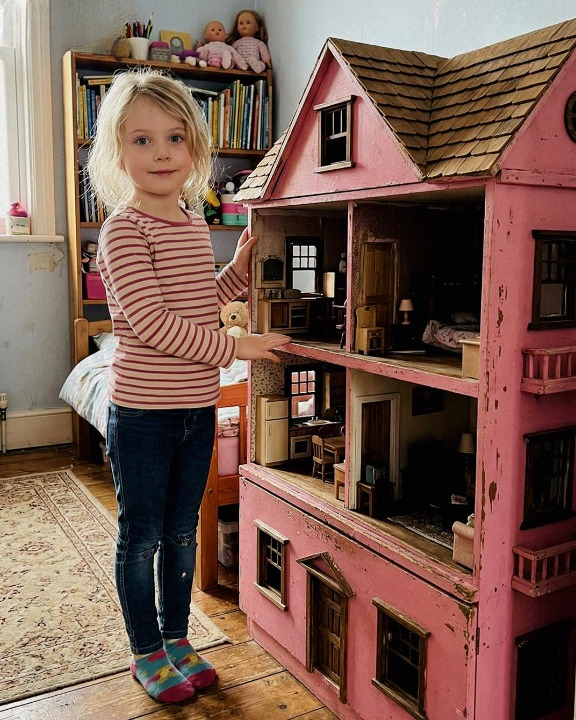
It had been exactly a year since my daughter vanished from our backyard. Last week, while going through her things, I found something hidden in her dollhouse that made me call 911 before I even fully understood what I was seeing. I wish I could say what happened next brought relief. It did—but only partly.
I started packing up Nancy’s room last Monday. The house had become too big, too quiet, filled with untouched remnants of her life: a cereal bowl left on the counter, her winter coat on the hook, a juice box on her nightstand with the straw still in it. For a year, I hadn’t moved a thing, afraid it would erase her memory.
Her father, Shawn, had died in a crash less than three months before she disappeared. Nancy was only nine when she went missing. Detectives said grief could make children wander. Search teams, dogs, helicopters—they tried everything. But eventually, the calls slowed, the flyers came down, and my mother-in-law, Cynthia, cut me off completely after a bitter phone call blaming me for everything.
I stayed in that house for months, waiting for a clue, a call—anything to prove my daughter was still out there. Finally, I decided to move in with my mother. The last thing I packed was Nancy’s dollhouse, built by Shawn during weekend evenings while she handed him sandpaper in the doorway.
As I wiped dust from the miniature attic, my fingernail caught on a loose floor panel. Using tweezers, I lifted it and found a folded sheet of thick paper. I recognized the handwriting immediately—Shawn’s blue pencil, a perfectly drawn compass rose, roads and distances, and in the center, a red X marking a spot nearly a hundred miles away. Something told me I couldn’t ignore it.
I called 911 as I set out, telling them what I had found and where I was going.
The GPS died at mile marker 47 on Route 9. I followed the map, driving until the pavement ended, then continued on foot. The forest grew thick and dark, but I pressed on.
Then I heard it: a small voice calling, “Dad… I miss you.”
I stepped into a clearing and froze. There, on the other side, stood a three-story wooden house, old but cared for, with a porch and a garden. Carved into the doorframe were the words: “Nancy, my beloved princess.” My heart stopped. The house was a life-sized version of her dollhouse.
And there she was. Alive, sitting cross-legged on the porch steps, absorbed in a miniature town she had built from sticks and stones.
I called her name, and she looked up. “Mom?”
Twelve months of fear and grief collapsed in an instant. I hugged her tightly, but her hand rested lightly on something beside her. It was Cynthia. For the first time, my mother-in-law looked genuinely surprised.
“You weren’t supposed to find us,” Cynthia gasped.
“Why is Nancy here? How could you take her?”
“She’s where she belongs. With me.”
I confronted her. She insisted it was for Nancy’s stability, that she had kept her safe under a different name, and that Shawn had secretly built this house for her birthday. Cynthia had tried to protect Nancy from my grief, from the pain of losing Shawn.
“While I was falling apart?” I demanded.
“Yes,” she said, her voice trembling. “I thought I was giving her stability.”
I refused to forgive her for keeping my daughter from me. Nancy, listening quietly, finally asked, “Why didn’t you tell me Mom was looking for me?”
“I did,” I said softly. “Every single day.”
The police arrived within minutes. Cynthia didn’t resist; Nancy held my hand tightly, crying softly all the way home.
Back in her room, everything was exactly as she left it—the juice box, her coat, her drawings. She asked if Cynthia could still visit, and I explained she always would be her grandmother, but she had to face consequences for her choices.
That night, as Nancy slept safely, I sat in the doorway, grateful that my daughter was home. Nothing would take her from me again.