
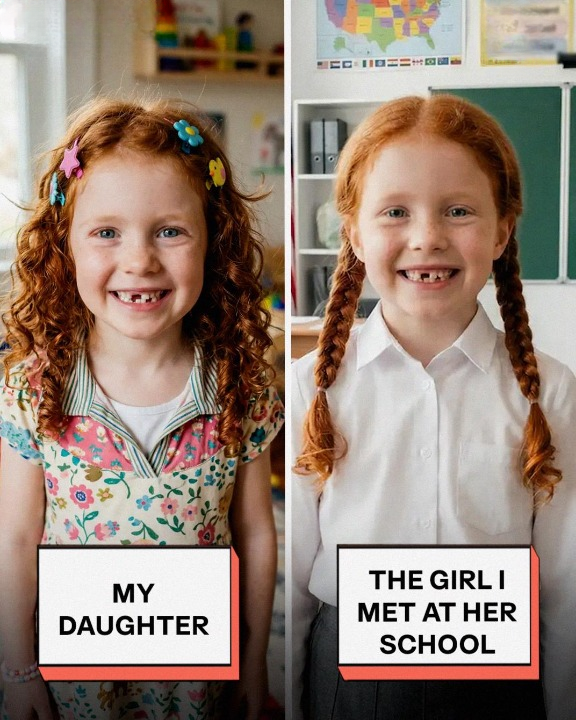
I lost one of my twin daughters three years ago and have lived every day since in the shadow of that grief. So when my surviving daughter’s first-grade teacher casually said, “Both of your girls are doing great,” I felt my breath catch immediately.
The memory of losing Ava is still vivid in its most painful fragments—her sudden illness, the terrifying diagnosis of meningitis, the hospital lights, and then the unbearable silence that followed her death just days later. After that, I stopped living in any real sense. I functioned for my remaining daughter, Lily, but everything inside me stayed frozen in that moment of loss.
We eventually moved away to start over, hoping distance might make breathing easier. Lily was finally starting first grade, excited and full of life, and for a brief moment that morning, I allowed myself to feel normal again.
But that afternoon at school, everything shifted.
A teacher greeted me warmly and mentioned that “both girls” were doing well. I corrected her immediately—Lily is my only daughter. But the teacher insisted there had been confusion, mentioning another child who looked strikingly similar.
Something in me refused to let it go, even as I tried to rationalize it. I followed her down the hallway, telling myself it was just coincidence, just grief playing tricks on my mind.
Then I saw her.
A little girl in the classroom who looked uncannily like my daughter—and like the child I had buried three years earlier. The resemblance was so overwhelming, so exact in expression and movement, that it physically overwhelmed me.
I collapsed shortly after.
When I woke up, my husband tried to ground me in reality, insisting I was confusing memory with grief and trauma. But I couldn’t let go of what I saw, so we agreed to investigate further.
The children’s families were brought into the situation, and eventually, a DNA test was done to settle the unbearable question.
The results were definitive: the girl was not my deceased daughter.
She was not Ava.
She was simply another child who happened to resemble her in a way that grief had made unbearable for me to process.
In the aftermath, everything shifted inside me. The pain didn’t disappear, but something finally loosened. I was able to understand that what I had seen wasn’t a miracle or a return—it was coincidence shaped into something unrecognizable by grief.
And in accepting that truth, I was finally able to say goodbye to the daughter I lost.
Not by getting her back—but by letting her rest.