
When we moved to a new town, I truly believed my daughter would finally fit in. Instead, a cruel prank in science class turned into a painful lesson—and what happened afterward changed everything for both of us.
If you’ve never knelt in front of your child outside a principal’s office, trying to pull gum from her hair, you don’t know that kind of heartbreak.
I’m Katie—a newly divorced single mom—trying to give my daughter, Jenny, a fresh start.
“No more being the ‘weird girl,’” I had promised her. “No more eating alone. This time will be different.”
That promise lasted three weeks.
The morning it happened, I could already tell something was wrong. Jenny sat quietly at breakfast, barely touching her food.
“You okay, bug?” I asked.
“I guess,” she muttered. “Just school stuff.”
I tried to lighten the mood, even joked about quizzing her on science. For a moment, she almost smiled.
Before leaving, she pulled on her favorite worn purple hoodie and said softly, “Maybe I’ll make a friend today.”
“You will,” I told her. “This place is better.”
She looked at me, hopeful. “I hope so.”
By lunchtime, the school called.
“There’s been an incident involving Jenny. Please come in.”
My heart dropped.
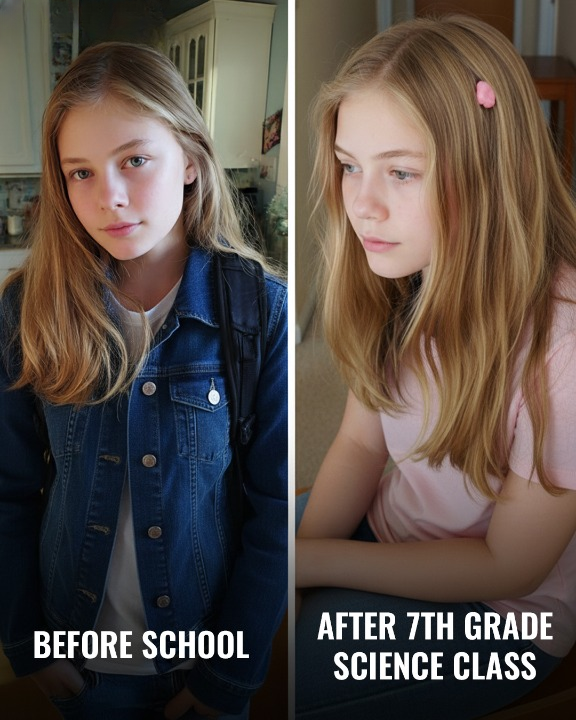
When I arrived, I found her sitting outside the office, her hair tangled—gum stuck deep in the strands.
“Three girls from science class,” she said quietly. “They did it while the teacher stepped out… and then they laughed.”
I was furious—but before I could react, she surprised me.
“I already handled it,” she said.
“How?”
“I asked them to say what they did… out loud. In front of everyone.”
Inside the office, the three girls sat with their mothers, avoiding eye contact.
Jenny spoke calmly, recounting exactly what happened.
One of the mothers tried to brush it off as a joke—but Jenny didn’t back down.
“It wasn’t a joke to me,” she said firmly.
The teacher confirmed everything.
Then Jenny made her request:
“I don’t want them suspended. I just want them to admit what they did… to my face.”
One by one, the girls apologized—awkward, embarrassed, and shaken.
The room shifted. Even their parents began to realize the truth.
The principal praised Jenny’s courage, and the teacher spoke about how kind and helpful she had been since arriving.
I sat there, overwhelmed with pride.
Afterward, one of the girls ran up to her, nearly in tears, begging for forgiveness.
But Jenny didn’t gloat. She didn’t need to.
She had already won—with quiet strength.
That evening, I carefully worked the gum out of her hair, strand by strand.
“I don’t want to be invisible,” she told me softly. “But I don’t want to change who I am either.”
“You don’t have to,” I said. “You’re perfect as you are.”
The next day at school, things were different.
Jenny walked in with her head held high. The girls who had bullied her kept their distance.
At lunch, another girl sat beside her.
“I heard what happened,” she said. “You were really brave. Want to work together?”
Jenny smiled. “Yeah… I’d like that.”
A week later, at the science fair, Jenny presented her project—a solar-powered water filter.
When the principal announced the winner, it was her.
The applause filled the gym.
Even the girls who had hurt her stepped forward to apologize again—this time sincerely.
On the way home, I looked at her and said, “You handled everything so well.”
She smiled, a little stronger now.
“Maybe it’s okay to be seen after all.”
And in that moment, I realized something:
I had been trying so hard to protect her from the world…
that I hadn’t noticed she was already strong enough to face it.