
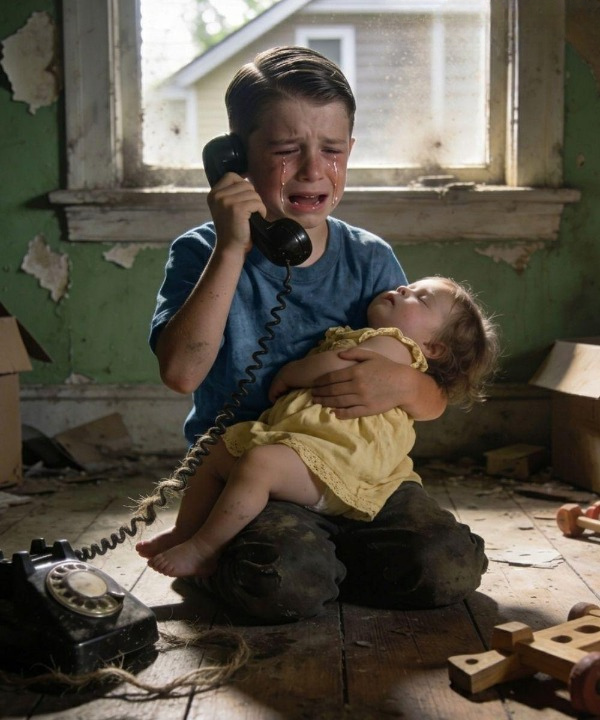
During a meeting in his Nashville office, Rowan Mercer almost ignored a call from an unknown number, assuming it was just another interruption. That split-second hesitation would haunt him—because the call was the moment everything changed.
He answered, distracted. For a brief moment, there was only static… then a small, tense voice came through:
“Dad?”
Rowan was on his feet instantly. “Micah? Why are you calling from another phone? What’s happening?”
Micah tried to sound calm, but fear laced his words. “Dad… Elsie won’t wake up properly. She’s really hot. Mom isn’t here… and there’s no food left.”
In an instant, everything else disappeared—the meeting, the noise, the people. Only his children mattered.
He ran. Calls to Delaney went unanswered. One after another, nothing.
By the time he reached his car, his hands were trembling. He drove straight to the house, replaying Micah’s words over and over.
When he arrived, something felt off—too quiet. He knocked. No answer.
Inside, he found Micah on the floor, clutching a pillow, silent in a way no child should be. “I thought you weren’t coming,” the boy whispered.
Rowan dropped to his knees. “I’m here. Where’s your sister?”
Micah pointed to the couch. Elsie lay there, pale and flushed, barely responsive. Rowan felt her forehead—burning hot.
“We’re leaving now,” he said, forcing calm into his voice.
In the kitchen, the truth was obvious: no food, an empty cereal box, a nearly bare fridge, and leftover dishes.
At the hospital, doctors confirmed Elsie was severely dehydrated and ill—but she had made it in time. Micah had saved her.
Later, Rowan learned the full story. Delaney had been in an accident days earlier and never returned home. Meanwhile, two young children were left to fend for themselves, one forced into responsibilities no child should bear.
Rowan made a choice. He stepped in fully—for their safety, for their future.
The following weeks were hard. Micah battled fear. Elsie resisted being alone. But Rowan stayed—every day, every moment—rebuilding stability through meals, routines, and quiet reassurance.
Delaney, meanwhile, confronted what had happened, sought help, and slowly worked to rebuild trust.
Progress came gradually—but it came.
In court, Rowan didn’t fight to win; he fought to protect. The outcome struck a balance: the children remained primarily with him, while Delaney was given guided time to regain her role.
Over time, something new emerged—not the old family, but a stronger one, built on honesty, responsibility, and steady care.
Micah summed it up best:
“I like it when nobody fights and everyone tells the truth.”
And Elsie, with a simple drawing of two houses joined by a rainbow, showed what mattered most: they were still a family.
Just in a different form.
Because sometimes, when everything falls apart, what you rebuild isn’t what you lost—it’s something stronger, safer, and more real.