
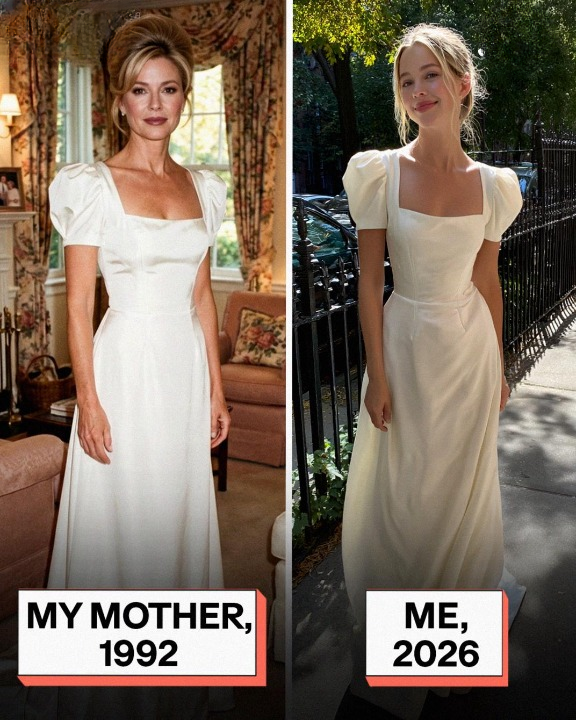
My stepmother destroyed my late mother’s wedding dress the morning of my wedding, calling it outdated and useless. I arrived at the church in tears—but the shock wasn’t on me. Everyone’s eyes went to her, and what happened next left the entire room speechless.
Lana stood in my bedroom doorway, arms crossed, glaring at the dress hanging from my closet. “I’m not letting you walk down the aisle in that… thing.”
It was my mother’s wedding dress—the very gown I had planned to wear.
“It’s not a thing,” I said.
“It’s thirty years old, Avery. Yellowing lace, puffed sleeves, totally outdated. You’ll look ridiculous,” she sneered.
“That’s all I have left of my mother,” I whispered.
Her expression hardened. “I’m your mother now. This is how you thank me?” She turned and left in a swirl of perfume and superiority.
When I was little, my mom would lay out that dress once a year, letting me breathe in its scent and dream of wearing it someday. Then she got sick—and then she died.
Two years later, Dad married Lana, who systematically erased everything that reminded me of Mom: photos, furniture, even the garden. The only thing she couldn’t touch was the dress, which I had hidden in my closet.
But with my wedding approaching, I thought it would be safe. I underestimated her.
Three days later, she cornered me in the kitchen with a tablet. “I’ve spoken to a designer,” she said, showing a stark, modern gown. “It’s for someone like you—someone who wants to look good at her wedding.”
“This is my dress,” I said.
“You have fabric and sentiment, not a wedding gown,” she replied.
She tried to recruit Dad that evening, claiming I’d embarrass myself. I refused to back down.
Two days before the wedding, Lana flaunted her own designer dress. I stayed silent, letting her pride shine while I prepared.
On the morning of the wedding, I opened Mom’s dress—and froze. One sleeve was nearly torn off, the bodice stained, lace slashed.
“Oh,” Lana said lightly behind me. “You found it.”
“Did you do this? This is my mother’s dress!” I cried.
“I saved you from humiliating yourself,” she said.
I was devastated. Nina, my maid of honor, rushed to help me. We ran to a bridal boutique, tears and panic filling the fitting room, but eventually I found a replacement gown.
At the church, as I walked down the aisle, a hush fell over the room—not because of me, but because of Lana. Her custom dress began to split along the seam, threatening to fall apart entirely in front of the entire congregation.
“You said my mother’s dress would fall apart,” I told her. “It lasted thirty years until you ruined it. Yours couldn’t last ten minutes, and you had the nerve to lecture me?”
Whispers spread through the pews. One of her friends, Mrs. Hargrove, spoke up: “I knew it. This wasn’t couture. You lied about it.”
For the first time, Lana’s façade crumbled in public.
I turned to my husband, Daniel, and finally felt at peace. The dress was gone, but Lana’s deception had been exposed. The memory of my mother endured, and I felt a sense of closure I hadn’t realized I needed.
Her attempt to erase my mother had failed—and in the process, she revealed herself for who she truly was.