
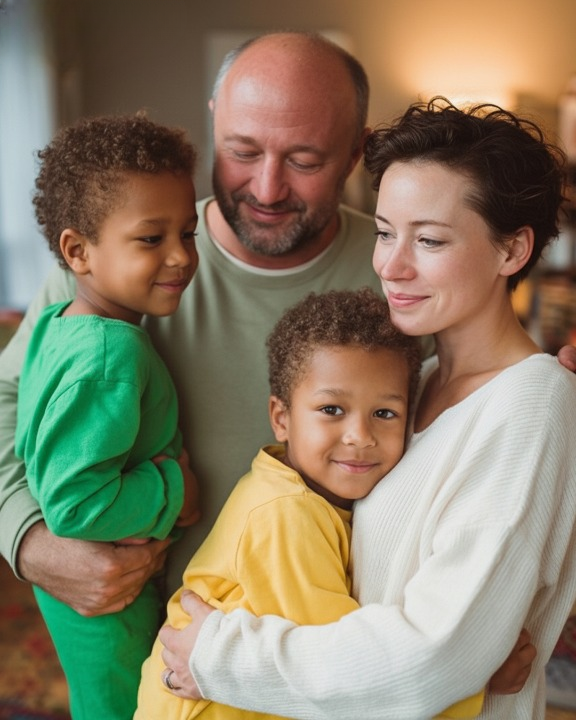
For years, I believed my husband’s dream of adoption was about giving us the family we’d always wanted. But when a hidden truth about his health came to light, our new life was thrown into chaos, forcing me to choose between confronting betrayal or fighting for the love—and the family—we’d built together.
Joshua had spent a decade helping me accept life without children. Then, almost suddenly, he became determined to give us a family. At first, I didn’t understand his urgency. I buried myself in work, he took up quiet hobbies, and we learned to live in our too-quiet home without acknowledging the emptiness.
It started subtly. One day, passing a playground, Joshua froze and watched the kids playing. “Remember when we thought that’d be us?” he murmured. There was a hunger in his eyes I hadn’t seen in years. Soon after, he slid an adoption brochure across the table. “Our house feels empty. We could do this. We could still have a family,” he pleaded. He had never begged before—it should have warned me.
Within a week, I quit my job. Nights became filled with forms, home studies, and preparation for the adoption. When Joshua found a profile for four-year-old twins, Matthew and William, he was instantly drawn to them. “Maybe we could be enough for them,” he said. I wanted to try. That night, he emailed the agency, and the boys soon came to live with us.
Life with the twins was chaotic but full of magic: bedtime stories, pancake mornings, LEGO towers, and two little boys slowly learning to trust us. I found myself staying up, watching over them as they slept, and learning the subtle ways children reach for safety and love.
But Joshua began to drift away. He came home late, hid in his office, claimed work emergencies, and gradually removed himself from daily life with the boys. I was left managing the spills, tantrums, and sleepless nights alone.
Then, one afternoon, I overheard him on the phone, speaking to Dr. Samson. He confessed he hadn’t adopted the boys solely for us. His voice cracked as he revealed the truth: he had a terminal diagnosis—lymphoma—and didn’t want me to face it alone. He had orchestrated the adoption to ensure I wouldn’t be alone, even as he prepared for a future he feared might not include him.
Shock and anger gripped me. Joshua had let me quit my job, fall in love with the boys, and build a family—all while knowing his time could be limited. I packed a bag with the twins, called my sister, and left, needing space to process the truth.
After confirming the diagnosis and treatment options with Dr. Samson, I returned home. Joshua, pale and exhausted, was at the kitchen table. The conversation was raw, painful, and necessary. He had protected me in the only way he knew—but at a cost. Together, we faced the reality of his illness while keeping our family intact.
Months of treatment tested us, with tears, laughter, and small moments of courage. The boys reminded us every day what love looked like in practice—messy, unpredictable, and unconditional. One morning, Dr. Samson called: Joshua was in remission.
Two years later, our home is alive with the noise, chaos, and love of backpacks, crayons, and soccer cleats. Joshua often tells the boys I am the bravest person he knows. I always respond: “Being brave isn’t staying quiet—it’s telling the truth before it’s too late.”
In the end, Joshua hadn’t just wanted a family for me—he had wanted us to survive, together, even in the face of fear. The truth nearly broke us. But it also saved us.