
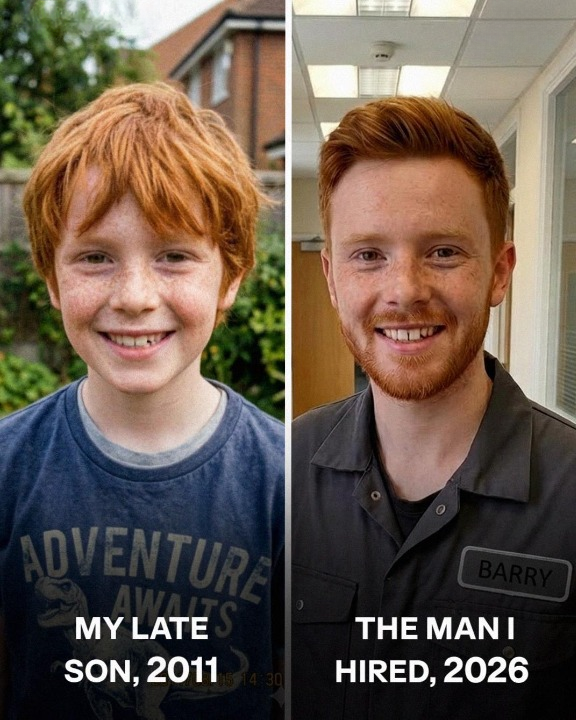
I laid my son to rest many years ago, and ever since, I’ve lived with the quiet he left behind. Then one day, I saw a photograph of a man who looked exactly like the boy I had lost.
My son, Barry, was only eleven when he disappeared. He had sandy blond hair and a shy smile I never forgot. His disappearance shattered our lives.
For months, people searched—police dragged the quarry lake, volunteers combed through forests, and my wife, Karen, and I waited endlessly for news. None ever came. Eventually, the authorities told us they had to assume he was gone.
Karen broke down. I went numb.
We never had more children. The fear of losing another was too much, so I buried myself in work at my small hardware store. Years passed like that.
Then one afternoon, while reviewing applications for a janitor position, I noticed a résumé that stopped me cold. The applicant’s name was Barry. That alone meant little—but the photo did.
The man was 26, with darker hair and a more hardened look, but something about him was unmistakable. The shape of his face, his expression—it was as if I were seeing what my son might have grown into.
There was a seven-year gap in his work history. He had spent that time in prison.
Most people would’ve dismissed him. I didn’t. I called him in.
At the interview, he admitted his past without excuses. He said he’d made mistakes and wanted a chance to prove he had changed. Sitting across from him felt surreal.
I hired him on the spot.
My wife was furious when she found out. She didn’t trust him and feared what might happen. But I stood by my decision, even though I couldn’t fully explain why.
Barry proved himself quickly. He was always early, worked hard, and treated everyone with respect. Over time, we began talking more, and eventually, I invited him to dinner.
Though my wife was uncomfortable, Barry became a regular presence in our home. I found myself enjoying his company in a way that felt familiar—like the bond between a father and son.
Karen noticed too, and it troubled her.
One evening, during dinner, everything changed.
Barry seemed uneasy, barely touching his food. Then he dropped his fork, and suddenly Karen slammed her hand on the table.
“How long are you going to keep lying?” she demanded. “When will you tell him the truth?”
I was stunned and tried to calm her, but she wouldn’t stop. She accused him of hiding what he had done to our son.
My heart nearly stopped.
I asked Barry what she meant. At first, he couldn’t look at me. Then, quietly, he admitted she was telling the truth.
He explained that, as a boy, he had fallen in with older kids who pressured him into dangerous dares. One day, they told him to meet them at the abandoned quarry. Afraid to go alone, he invited my son—who trusted him.
At the quarry, the older boys dared them to walk along a narrow ledge above the water. Terrified, Barry ran away.
My son stayed.
Later, one of the older boys admitted that my son had slipped and fallen. They panicked and fled, saying nothing.
Barry carried that guilt for years. When he eventually confronted one of the boys as an adult, it led to a violent fight and his time in prison. Afterward, he tried to rebuild his life—and came looking for me, intending to tell the truth, but never finding the courage.
That night, I walked out, overwhelmed.
The next morning, I returned to the store. Barry was already there, nervous and waiting.
I told him the reason I had hired him—because he looked like my son. For a long time, I believed it was more than coincidence.
But now, I saw things differently.
He wasn’t my son. He was a man who had made a mistake as a frightened child and carried the weight of it ever since.
I told him my son deserved peace—and so did he.
Then I put my hand on his shoulder and told him he still had a job, and a place in my life.
For the first time in years, it felt like something inside me had finally settled.