
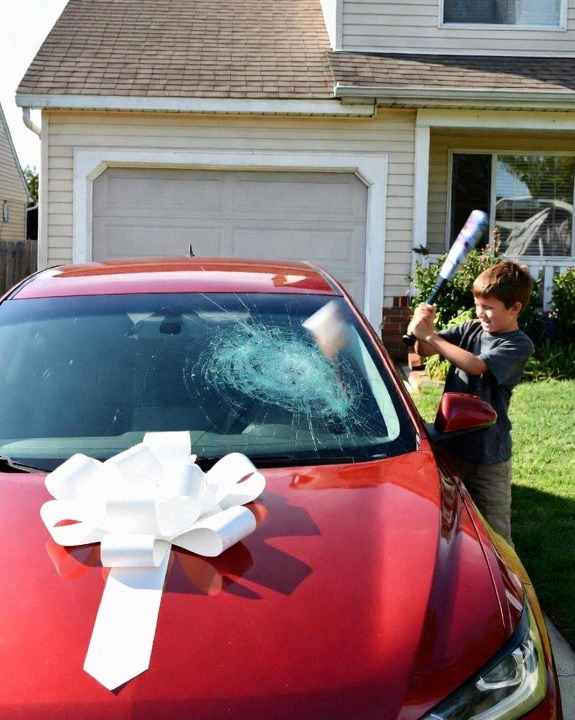
My nephew had been badly behaved for as long as I could remember, and my sister always brushed it off as “gentle parenting.” But the day he took a baseball bat to my brand-new car while my sister stood nearby laughing, something in me shifted. I didn’t yell. I didn’t cry. I just became very calm — and that’s the moment my sister should have started to worry.
Before explaining what happened to my car, you need to understand what my nephew Jeremy was like.
Jeremy is ten years old, and since he was about five, he has pushed the limits everywhere he goes. He ignores rules, talks back to adults, and treats other people’s belongings as if they’re just toys in a game he’s playing.
My sister, Kelsey, insists this is all part of “gentle parenting.” I have a different opinion, but I usually keep it to myself.
Whenever someone in the family tried to correct Jeremy, Kelsey would always respond the same way: “You’re interfering with his development.”
She said it when Jeremy dumped pasta onto our cousin’s lap at Thanksgiving because he wanted to sit at the adults’ table. She said it again after he knocked over a display at a hardware store and simply walked away.
Eventually, most of the family stopped saying anything at all. Dealing with Kelsey’s reaction was often harder than dealing with Jeremy’s behavior.
One time I told her directly, “Kelsey, your son is going to seriously hurt someone one day.”
She laughed it off and told me I sounded like our mother.
The clearest example of the situation happened at our grandmother’s 80th birthday party last spring.
My mom had ordered a beautiful three-layer vanilla cake with white frosting and decorative flowers. Jeremy wanted chocolate instead. When no one changed the cake, he grabbed a serving spatula and shoved the top tier right off the stand.
The cake slid down the dining room wall, leaving a streak of frosting across the wallpaper. My grandmother simply stood there quietly, realizing it wasn’t worth arguing.
Later, when my mother tried to give a toast, Jeremy loudly talked over her and used language no ten-year-old should be using — especially toward his own grandmother. Then he demanded the chair my pregnant cousin was sitting in until she finally gave it up.
Kelsey watched all of it calmly and told me he was just “having a difficult day.”
A few months later, I bought my dream car — a brand-new dark green SUV that I had been saving for over four years to afford. When I drove it home, I sat in the parking lot for several minutes just enjoying the moment.
My mother suggested we celebrate with a small family gathering at my apartment. I agreed, although I knew that meant inviting Kelsey and Jeremy.
Before everyone arrived, I pulled my sister aside.
“Please keep an eye on Jeremy tonight,” I said. “Just make sure he stays away from the car.”
Kelsey smiled and said there was no way her son would do anything wrong.
Strangely, Jeremy behaved perfectly that evening. He sat quietly, said “please” and “thank you,” and didn’t touch anything he shouldn’t. Looking back, it was almost suspiciously perfect.
At one point I carried a stack of dirty plates into the kitchen. As I walked back toward the door, I suddenly heard my car alarm and a loud crashing sound.
I ran outside.
Jeremy was standing in the driveway with a wooden baseball bat, smashing the hood of my car. The windshield was already cracked from one end to the other.
Kelsey stood nearby watching — and laughing.
I rushed forward and told Jeremy to stop. Trying to stay calm, I asked him why he was doing it.
He looked up at me and said confidently, “Mom told me to teach you a lesson.”
I turned toward Kelsey, stunned.
She shrugged and said it wasn’t a big deal. According to her, Jeremy was simply exploring and expressing himself. After all, she said, I could always buy another car.
That’s when I realized something important.
This wasn’t really about the car.
It was jealousy. My sister resented the fact that I had worked hard and bought something nice, while she and Jeremy struggled financially.
Instead of arguing or shouting, I went back inside and asked everyone to come outside quietly.
Then I began taking photos of the damage — every dent, every crack in the windshield, every mark on the car. I even asked Jeremy to stand next to the car while holding the bat, and I photographed that too.
Afterward, I contacted several repair shops and requested written estimates for the damage. Within an hour, I had two detailed quotes.
I printed them and handed them to Kelsey.
I explained that because she had encouraged Jeremy to do it, she was responsible for the cost of repairs.
She refused and left angrily with Jeremy.
But the story didn’t end there.
A few weeks earlier, Kelsey had asked me to co-sign a loan so she could buy a house. She couldn’t qualify on her own because of her credit score.
After what had happened, I called the bank and withdrew my name from the application. I also informed a few relatives who had planned to help her financially about the situation.
Without that support, the house deal fell through.
Soon afterward, Kelsey came to see me again, upset and exhausted. This time she understood that the situation was serious.
Eventually she sold her small camping trailer — something she and Jeremy had used for family trips every summer — and used the money to pay for the repairs.
A few weeks later, my car came back from the shop looking exactly as it had the day I bought it.
Not long after that, I picked Jeremy up from school one afternoon. While we were driving, he looked carefully at the windshield where the crack had once been.
“You can’t even tell it was broken,” he said quietly.
“They replaced the whole thing,” I explained.
He sat quietly for a moment.
Then he said something that surprised me.
“I’m sorry about your car, Aunt Kristen.”
It sounded like the first real apology he had ever given.
And in that moment, I realized something.
Jeremy finally learned that actions have consequences.
And my sister learned that protecting someone from consequences isn’t gentle parenting at all.