
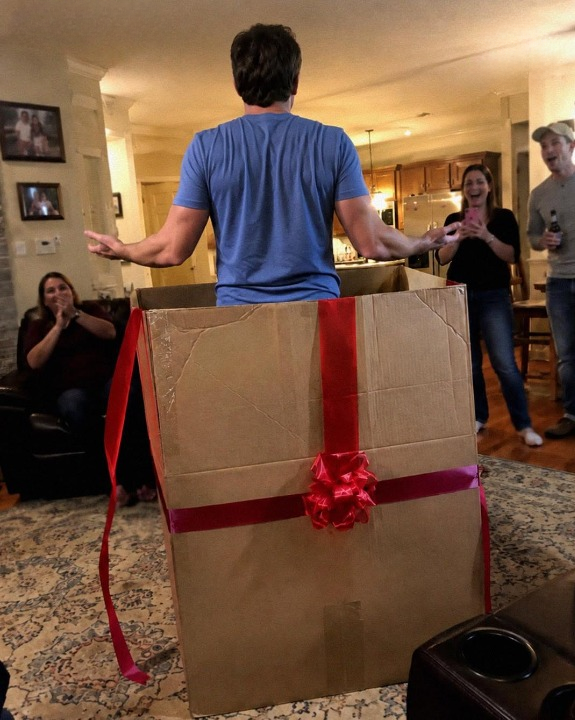
When my husband rolled a huge gift box into my birthday party, I thought I was about to be spoiled. Instead, I realized how little he actually understood me.
I never imagined my marriage would end at my own birthday celebration.
If you had asked me that morning how things were between us, I probably would’ve said, “Complicated, but fine.” That was my usual answer for something that had been off for a long time, something I’d learned to tiptoe around.
My husband, Ethan, had spent weeks building up this “life-changing” birthday surprise. He kept insisting it would be unforgettable, saying things like, “This is going to change everything,” and “You’ll never see a birthday like this again.” He wore that smug little smile that should’ve warned me more than it did.
A few days before the party, he vanished for half a day. When he came back, he looked overly pleased with himself, like he had pulled off something major. I remember watching him and thinking he was either planning something sweet… or something completely reckless. I ignored the warning sign.
That was the pattern with Ethan. He believed shock value was the same as humor, often making me the joke in front of others, then calling me “too sensitive” when I didn’t laugh. Any time I reacted, somehow I became the problem. Over time, I learned to swallow discomfort just to keep the peace.
So when he started hyping up my birthday surprise, part of me felt excited—but another part felt uneasy.
Two nights before the party, I told my sister Nina. She laughed and said, “Life-changing? From Ethan?” then joked maybe he’d finally bought the freezer we needed. I laughed too, but her words stuck with me.
Honestly, I wouldn’t have minded a practical gift. I just wanted to feel like he listened.
On my birthday, the house was full—friends, coworkers, family, even my manager. Music played, lights were strung up, snacks everywhere. It should’ve felt warm. Instead, I had that uneasy feeling that something wasn’t right.
I found Ethan checking his phone repeatedly. When I asked him about it, he brushed it off and told me to trust him. That phrase again.
A couple of months earlier, I had already seen suspicious messages on his phone from a woman named Jade—messages he later dismissed as jokes and blamed me for questioning. I had let it go back then, even though I knew something didn’t add up.
So when he kept acting secretive at my party, that same discomfort returned.
Eventually, he announced it was time for the surprise. Two men brought in an oversized wrapped box and placed it in the center of the room. Ethan treated it like a grand reveal, clearly enjoying the attention.
When the box shifted slightly from inside, people laughed, assuming it was part of the act. But I didn’t feel amused.
I asked him what was going on. He just told me to relax.
Then he made me close my eyes.
“Three… two… one…”
The lid flew open.
A woman stepped out in heels and a satin robe, holding champagne.
And I recognized her instantly.
It was Jade.
The same woman from his messages.
The room went silent for a moment, then awkward laughter followed. Ethan looked proud, like he had orchestrated something impressive.
But I wasn’t smiling.
I asked who she was. He tried to pass it off as a “fun surprise,” claiming I would “get into it.” Jade, confused and embarrassed, said she thought I knew she was coming.
That’s when everything collapsed.
It became clear she had been lied to just as much as I had. Ethan insisted I was overreacting and called me dramatic, even as the truth was sitting right there in the room.
The atmosphere shifted fast. People stopped laughing. Phones went down. The performance was over.
Jade apologized, said she wouldn’t have come if she had known the truth, then left in humiliation.
But Ethan didn’t stop. Instead of owning what he’d done, he blamed me for ruining the moment, insisting I should have reacted differently and accused me of making him look bad in front of everyone.
Then came the argument in front of the entire room—him trying to justify it as “effort” and “initiative,” while I stood there realizing he genuinely believed I was the problem.
At one point, he said I was too “closed off” and that he was trying to bring “life” into our marriage. That was the moment something inside me shifted completely.
Because I understood then: he didn’t see what he did as betrayal. He saw it as my failure to appreciate it.
And I was done.
Not in a dramatic way. Just a quiet, final clarity.
I picked up my things and told him I was leaving. He accused me of ruining my own birthday. I told him I was leaving the situation he created.
Outside, I broke down completely in my sister’s arms.
She didn’t ask questions. She just told me I wasn’t going back in there.
Later that night, Ethan texted, asking where I was and blaming me for embarrassing him. I blocked him.
The next day, I returned to the house, packed my essentials, and left. On the counter was a note from him calling it a “misunderstanding.”
I left it behind.
The weeks that followed were a blur of divorce steps, conversations, and realization. Even people around me saw what had happened clearly: it wasn’t a joke or a surprise—it was a violation of trust disguised as entertainment.
Months later, I can say the hardest part wasn’t the public humiliation or the chaos of that night.
It was finally realizing I didn’t have to keep excusing it.
And strangely, that realization felt like freedom.
If there’s one thing I took from it, it’s this: when something feels wrong early on, it usually is.