At first glance, it seems like a straightforward visual puzzle, but it has confused many people online. Four identical glasses appear to be filled to the same level with water, yet each contains a different submerged object. The question is: which glass actually contains the most water? Many people answer quickly, only to realize their first assumption was misleading.
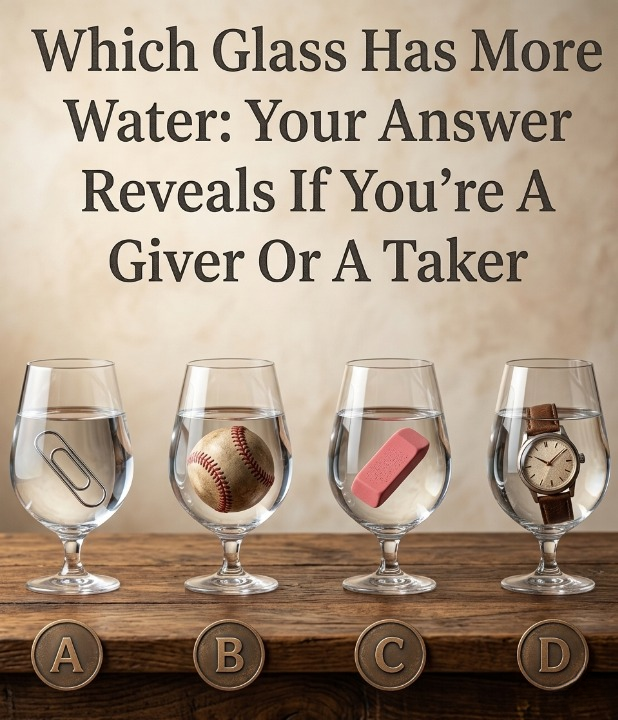
The setup shows four glasses labeled A, B, C, and D, each with a different object inside: a paperclip in A, a baseball in B, an eraser in C, and a wristwatch in D. Since the water levels look the same, it’s easy to assume the amount of water is also the same—but this is where the trick lies. The key concept is displacement.
Displacement means that when an object is placed in water, it takes up space and pushes some of the water aside. The larger the object, the more space it occupies, and the less water can remain in the glass. So even if all the glasses appear equally full, the actual amount of water differs depending on the size of the object inside.
Using this principle, the glass with the smallest object—the paperclip in Glass A—contains the most water, since it displaces the least amount of space. The baseball in Glass B takes up the most room, meaning it leaves the least space for water, with the other objects falling in between.
Puzzles like this are popular because they highlight how easily visual perception can be misleading. Our brains tend to rely on quick judgments, but those assumptions can ignore important details like physical principles at work. This challenge encourages more careful, logical thinking rather than snap decisions.
Beyond the logic, people sometimes attach personality interpretations to these kinds of puzzles, suggesting different thinking styles based on the choice made. While these interpretations are more for fun than science, they add another layer of engagement.
Overall, the puzzle is a reminder that things aren’t always what they seem at first glance. What looks equal on the surface can hide important differences underneath, and careful reasoning often reveals the correct answer.