
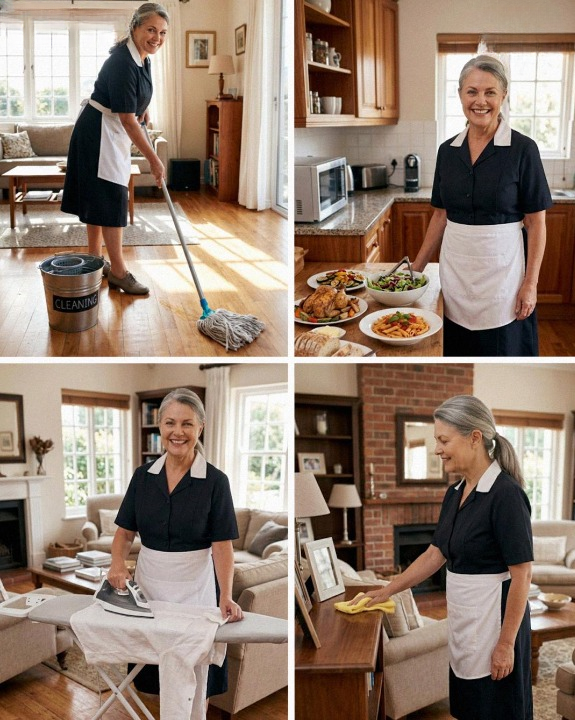
I thought marrying the man I loved would be the hardest part of starting my new life. I had no idea the real challenge would begin the moment his mother decided I wasn’t “enough.”
Elliot and I had just tied the knot. From the very start, his mother, Patricia, made it clear she didn’t think I was worthy of her son. I noticed it the first time she hugged me with one arm while sizing me up like I was a piece of furniture. Her smile never reached her eyes, and her politeness always carried a sharp edge.
Even before she officially became my mother-in-law, it was obvious Patricia loved being in control. Nothing I did escaped her criticism—whether I cooked dinner, folded laundry, or simply existed in her presence, she found fault.
Comments like:
“You’re loading the dishwasher wrong!”
“Didn’t your mother teach you to make a proper omelet?”
“What kind of lunch is that for Elliot?”
…echoed in my head long after she left. Elliot hated conflict and always tried to calm things with, “She means well,” or, “That’s just how she is.” I convinced myself I could manage one difficult mother-in-law.
But after our honeymoon, Patricia crossed a line. She showed up unannounced with a “surprise”—a woman named Marianne, hired to teach me how to be the “ideal wife.” She brought a color-coded binder and a strict schedule: 5 a.m. exercise to stay attractive, 6 a.m. breakfast for my husband, 7 a.m. clean the kitchen… and on it went until after 9 p.m., leaving barely a moment for my own life.
When I asked, “And when do I work? When do I have a life?” Patricia simply said, “A wife’s life is her family.” Elliot shrugged, refusing to intervene. Rage boiled inside me, but I realized tears or arguments would only prove her right.
So I smiled. “Of course, Patricia. What a wonderful surprise.”
Over the next week, I followed the course… deliberately poorly. Slightly undercooked meals, dust overlooked, lunches too simple. Patricia hovered, criticizing constantly, but she never demonstrated anything herself. That’s when I began testing my theory.
Whenever she complained, I calmly asked her to show me how it should be done. She stumbled, spilled, fumbled with appliances, and embarrassed herself repeatedly—while Marianne watched uncomfortably.
By the end of the week, I had recorded every session. One evening, I placed my phone on the table. “Listen,” I said. I played the clips of Patricia criticizing me while failing to demonstrate anything herself.
Elliot finally saw it. His silence had enabled her, but now he understood. “You were tearing her down, and I let it happen,” he admitted. Patricia had nothing left to twist or deny.
That night, Patricia left in shame. A week later, she sent a fruit basket with a short, handwritten note:
“I didn’t mean to try to control everything. I was afraid of losing my son to another woman. I’ll do better.”
Life didn’t magically become perfect, but it became balanced. Elliot chose our marriage, and I chose myself. Patricia never tried to “teach” me again—because finally, she realized I was never the one who needed fixing.