
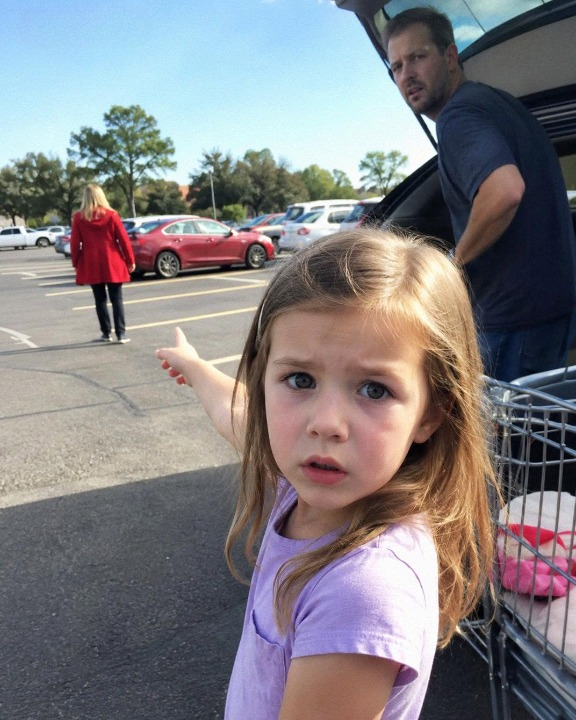
When my five-year-old pointed at a woman in a red car and said, “She pays Daddy to cry,” I assumed it was just a childish misunderstanding. But my husband’s reaction was instant panic—and it was the first crack in a secret he’d been carrying for two years.
Saturday afternoons in our house always followed the same routine: groceries, quiet roads, and Ivy singing softly in the back seat. I used to think that predictability meant safety.
Nolan was a steady man. The kind who fixed things without being asked, carried every bag in one trip, and never showed emotion when life got heavy. Not at his father’s funeral, not when Ivy was born, not even on the days he clearly should have.
So when he suddenly began staying late in the garage and waking up with tired, red eyes, I told myself it was just stress. Nothing more.
That Saturday at the supermarket parking lot felt ordinary. Nolan loaded the groceries while Ivy held my hand, swinging it gently.
Then a woman walked past us—blonde, wearing a red coat, stepping out of a red car.
I recognized her from a company event months earlier.
“Hi, Nolan,” she said casually.
He froze.
“Rachel,” he replied, his voice unusually tight.
She greeted me politely, then left.
That’s when Ivy pointed and said the words that changed everything.
“Mommy… the lady in the red car pays Daddy to cry.”
At first, I almost laughed. It sounded impossible.
But Nolan didn’t laugh.
He went rigid. His face drained of color. Then, sharply, he told Ivy to stop making things up—something he had never done before.
Confused and shaken, I pressed for answers, but he shut down completely. The rest of the drive home was silent.
Once we arrived, I confronted him in the kitchen.
“What does she mean?” I asked. “Don’t lie to me.”
He hesitated, gripping the counter like it was the only thing holding him up.
“Her name is Rachel,” he finally said.
“And what is she to you?” I demanded.
Before he could answer, the doorbell rang.
His relief at the interruption told me more than words ever could.
It was my sister.
Nolan used the delay to retreat into himself again, promising only that he would explain later. That night, I couldn’t sleep. The feeling that something didn’t add up wouldn’t leave me alone.
The next morning, I searched his desk and found a folder filled with payments made to Rachel over months—regular appointments, always the same time each week.
Nothing made sense until I checked his email.
There, I found messages labeled “Sessions.”
Rachel wasn’t a secret lover or someone he was hiding an affair with.
She was a grief therapist.
And Nolan had been attending sessions for months, processing the loss of our son—something we had both buried in silence but never truly healed from.
He had been paying for help, not betrayal. Crying in private because he believed he had to stay strong for both of us.
Even Ivy’s confusing words finally made sense—she had overheard therapy talk about crying, sessions, and payments, and misunderstood it in her childlike way.
When Nolan finally spoke again, he admitted he had carried the pain alone because he thought I couldn’t handle seeing him fall apart.
But the truth was, we had both been breaking in different ways—just quietly, and separately.
That night, for the first time in years, we stopped hiding our grief from each other.
And slowly, what felt like a betrayal turned into something else entirely: a shared beginning of healing neither of us had known how to start.