
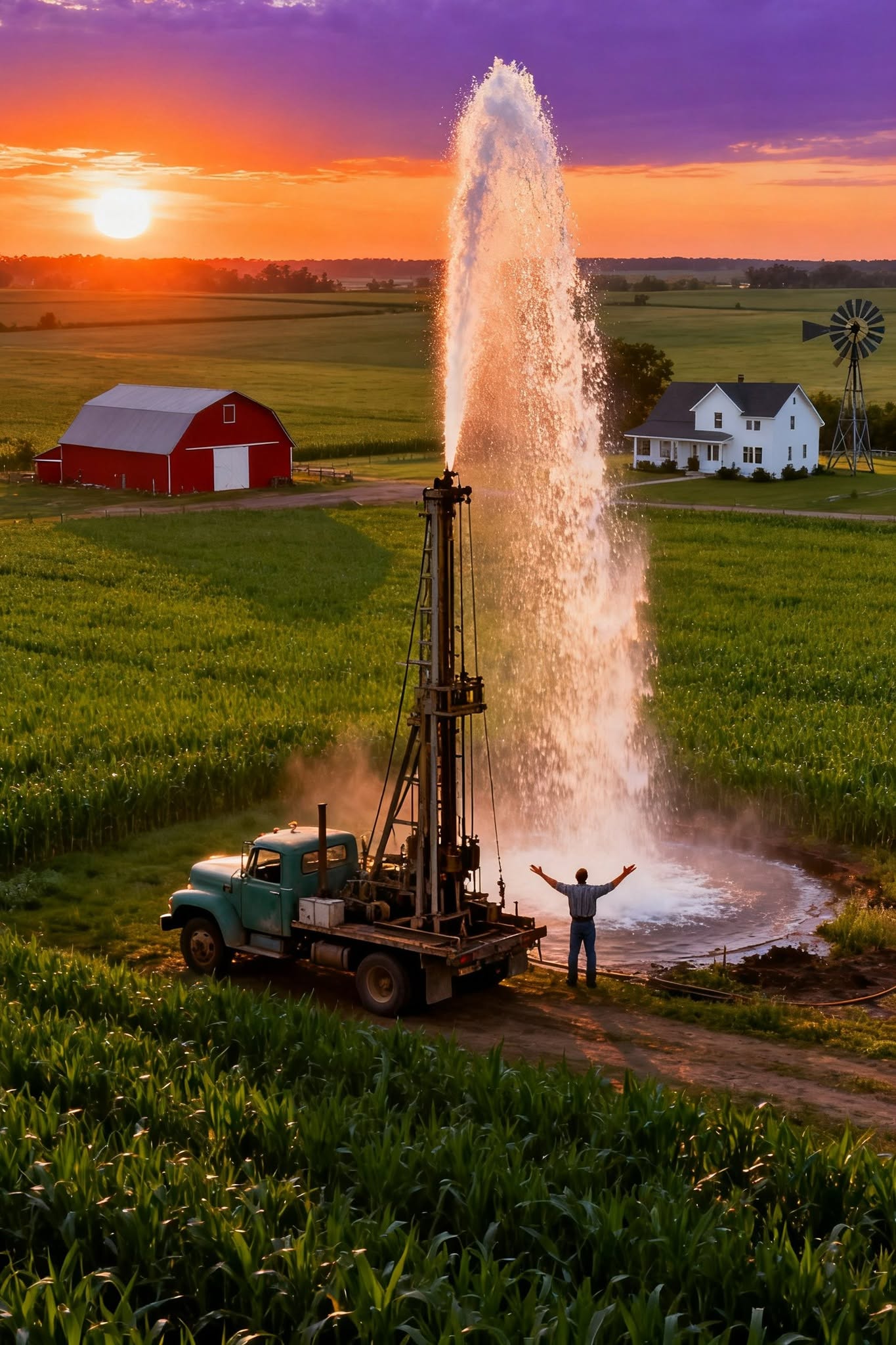
Harper County was locked in the grip of a brutal July drought. Fields that once fed livestock had turned into dry, gray dust that crunched under every step. For 62-year-old Eli Mercer, the family farm was a stubborn relic of three generations—bare barn roofs patched with scrap metal, a motionless windmill, and land that had slowly given up on itself.
But the real legend of the Mercer property wasn’t the farmhouse or the fields. It was the “dry hole” beyond the windmill—a deep well drilled in 1979 that never produced usable water. Locals mocked it as Mercer’s Folly, a reminder of wasted hope buried underground.
Across the road, Clayton Harlan lived in total contrast. Thousands of acres, modern irrigation systems, deep productive wells, and crops still green under steady spray. He didn’t just have success—he had control. And he never let others forget it.
Desperate to save his dying cattle, Eli swallowed his pride and drove to Clayton’s estate to ask for water. Standing at the gate, he made a simple request: to buy enough water to survive the week.
Clayton laughed in his face.
He mocked Eli’s failing farm, his “worthless” dry well, and told him men like him didn’t deserve modern farming. “Sell the cattle. Sell the land,” he said coldly. “Someone with sense should take over.”
Eli left empty-handed.
That night, instead of giving up, Eli went back through his father’s old drilling logs. Reading closely, he realized something others had missed for decades—the well wasn’t empty. It had water. It just didn’t recharge fast enough for old drilling methods.
The next morning, he dug deeper into county records with the help of the local clerk and discovered historical maps showing underground water flow patterns long before the land was altered. A new idea formed: instead of forcing water out, he would collect and filter it back in slowly.
Eli got to work.
He sold cattle to fund gravel, pipes, solar pumps, and concrete. He reopened the old well, built a filtration system of stone, sand, and charcoal, and created a basin to capture rainwater runoff. Day after day, he worked alone, rebuilding what others had written off.
By winter, the rain finally came—and the system worked. Water filtered through the ground, replenishing the once-dead well. Tests later confirmed it was clean, stable, and usable.
But success brought conflict.
When Clayton heard what happened, he didn’t celebrate—he attacked. He warned of regulations, filed complaints, and used his influence to try to shut Eli down.
Now the entire county is watching.
Because the same “worthless” well everyone once mocked might be about to become the one thing that saves them all.