
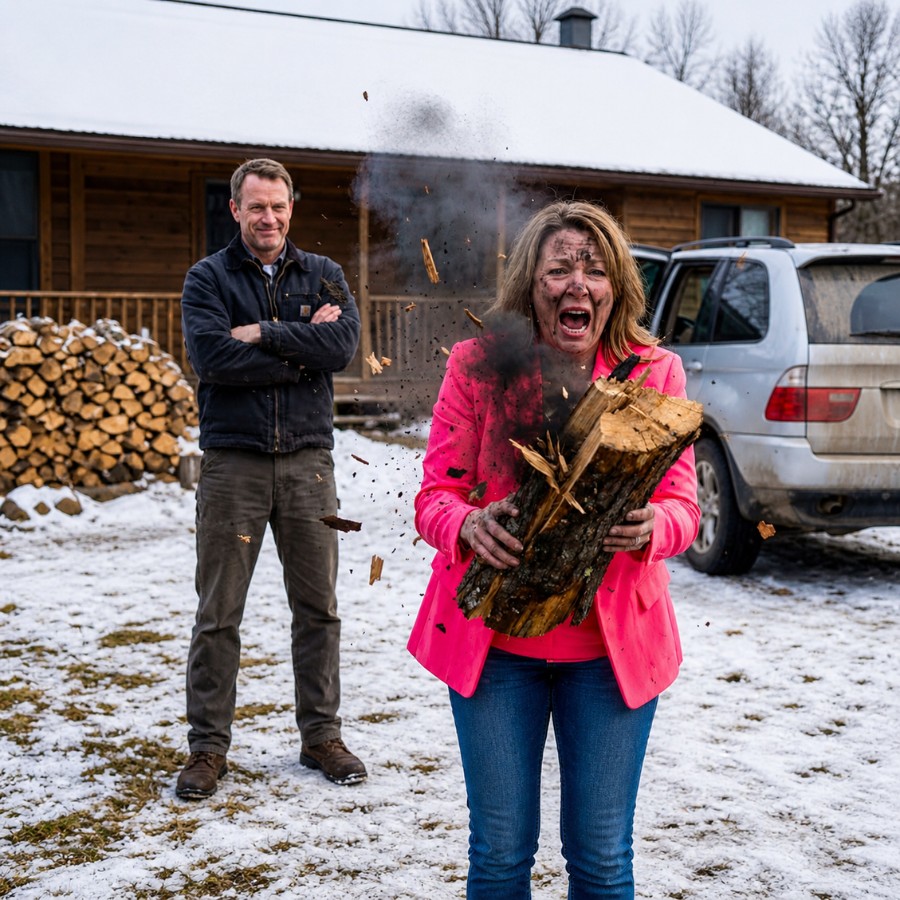
A dense, inky plume exploded from Delilah Thornfield’s Mercedes for a split second, as if winter itself had burst open and gone rotten. Charcoal powder flooded out through the open hatch, spilling across cream leather seats, swallowing the dashboard, and clinging to her white designer jacket until the so-called “queen of Pine Ridge Estates” looked like she’d climbed out of a burned chimney. Her perfect blonde hair—usually sculpted into an untouchable badge of authority—was now streaked with gray-black soot. Every frantic movement left dark handprints behind as she screamed.
“You insane psycho!” she coughed, more powder drifting out of the stolen wood piled in her SUV. “You tried to kill me!”
I stood at the end of my driveway with my cane and watched her finally wear the mess she’d created. Months of stolen firewood, months of denial—now all of it was right there in plain sight. Neighbors spilled out onto porches and doorways, phones raised to capture the scene. Her expensive SUV sat like a trophy of arrogance, its hatch wide open, stuffed with my firewood and now ruined beyond any hope of cleaning. It would have been almost funny—if it hadn’t taken so much patience and loss to reach this moment.
Three months earlier, there had been none of this. No chaos, no shouting, no exposure. Just me—Marcus “Mac” Caldwell, fifty-two, medically retired from the Army after an IED in Afghanistan left me with a permanent limp and a Purple Heart. Pine Ridge Estates wasn’t built for people like me. It was a place where others paid for convenience without ever thinking about cost.
I counted everything. Medication. Miles to the VA. Days my furnace might last before giving out completely. When it finally died during the first hard freeze of the season, I spent nearly everything I had left on two cords of oak. That firewood wasn’t luxury—it was survival. I stacked it with the same discipline I once used for ammunition crates, each log placed carefully, because it was the only thing standing between me and the cold.
Delilah Thornfield lived at the top of the street in the largest house in the neighborhood. As HOA president, she ruled like every rule was personal authority. Garden decorations disappeared under her orders, families repainted shutters on demand, and fines appeared for the smallest deviations. Most people obeyed, grumbled in private, and tried not to draw her attention.
The first time my wood went missing, I’d been at a VA appointment. When I returned, a third of it was gone, tire tracks pressed into the dirt behind the stack. I confronted her that same day. She denied everything without hesitation, standing in designer clothes while my missing wood sat visible just behind her property line.
From that moment on, I stopped assuming this was a misunderstanding.
I pulled records, checked bylaws, and found what she was really relying on: interpretation, intimidation, and the assumption that no one would challenge her. The rules she claimed didn’t exist in the way she presented them. Meanwhile, financial documents showed questionable HOA payments tied to her own business. The more I looked, the clearer the pattern became.
Then came the camera footage. Then the neighbors. Then the proof.
By the time the community gathered, the truth had already done most of the work. When Delilah tried to leave that final night, she opened her SUV to find exactly what she’d been stealing—turned against her. The blast of charcoal dust wasn’t dangerous, just unforgiving. Enough to expose everything at once.
And when the dust settled, so did the neighborhood.