
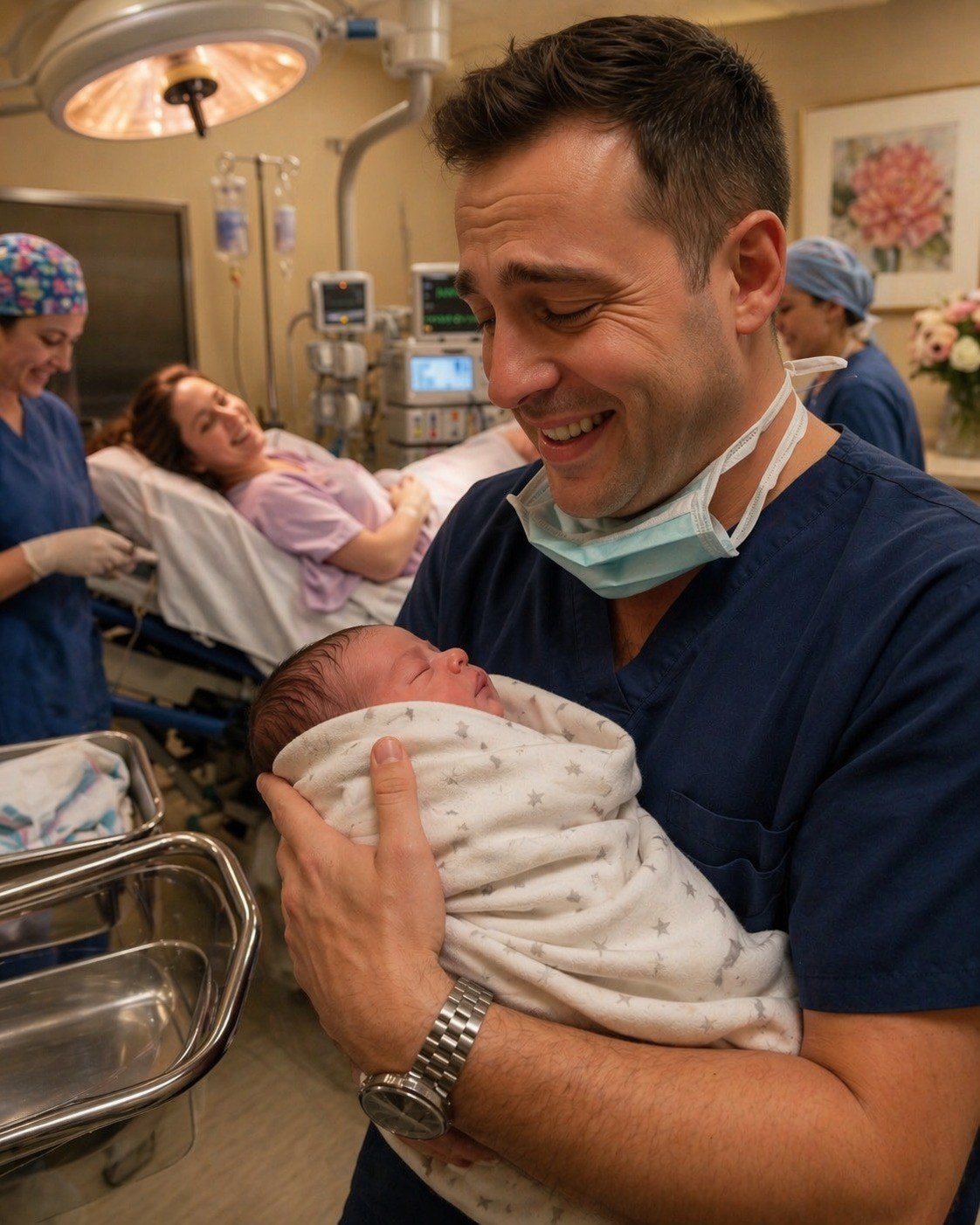
The antiseptic air of St. Jude’s Memorial carried the familiar strain of a night shift, yet for Dr. Julian Thorne—an experienced OB-GYN with over fifteen years in practice—something about this evening felt unusually weighty. He had witnessed everything from miraculous deliveries to heartbreaking losses, but nothing quite like the arrival of Elena Vance. She didn’t come by ambulance, nor was she accompanied by frantic family or a partner. She simply appeared at triage, one hand pressed to her abdomen, sweat on her brow, her expression locked in quiet endurance.
Elena had spent the entirety of her pregnancy alone. The moment her partner saw the positive test, he disappeared, leaving her to face every appointment, every scan, and every preparation without support. She attended ultrasounds by herself, bought baby clothes on her own, and prepared a small nursery in a silent apartment that seemed to echo her isolation. So when labor began, she didn’t call anyone. She packed her bag, drove herself to the hospital, and only stopped when the pain made it nearly impossible to see.
By the time Dr. Thorne arrived, labor was progressing rapidly. Elena had dismissed repeated offers of assistance, insisting she could manage on her own. There was a fierce resolve in her—almost defiant. Between contractions, she repeated that she had endured the entire pregnancy alone and would finish it the same way. Though cautious, Julian allowed her space while remaining close in case of emergency. Against expectations, and without pain relief or external support, she delivered a healthy baby boy within the hour.
Julian took over post-delivery care, working methodically as the newborn’s condition proved excellent and Elena’s vitals stabilized. Everything appeared routine, the kind of successful outcome he had seen countless times before. He proceeded with the final steps of delivery, expecting nothing unusual.
Then something unexpected broke the normal rhythm of the room.
During a routine examination, Julian felt something unusual—an object that clearly did not belong in the birth canal. Carefully, he retrieved it with forceps. A small metallic item clinked onto the surgical tray, drawing immediate attention. It was a tarnished silver locket, worn and aged, as if it had been trapped inside the body for years.
Julian’s expression shifted as he cleaned it under sterile gauze. An engraved crest became visible: a willow tree above a flowing stream. His hands stilled.
“Elena… where did you get this?” he asked quietly.
Exhausted and disoriented, she looked at the object—and then froze. Tears filled her eyes almost instantly.
“That was my mother’s,” she whispered. “I lost it when I was a child… after the accident. They never found it.”
Recognition struck Julian with sudden force. He remembered the case—years ago, when a young girl survived a devastating crash that took her parents. He had been a junior doctor then, part of the trauma team that fought to save her life. In the chaos of emergency surgeries and internal injuries, the locket must have been pushed deep into tissue, undetected for decades.
For twenty years, it had remained inside her unnoticed, carried through her entire life—through foster care, adulthood, and now childbirth—hidden just beneath the surface of her story. And now, with the physical strain of delivery, it had finally been pushed back into the light.
Julian sat down heavily, overwhelmed by the realization. The professional detachment he had relied on for years cracked. This wasn’t just a medical anomaly—it was a convergence of memory, survival, and time.
Elena held her newborn tightly, while the locket rested in her other hand, as if two generations had suddenly been placed together in a single moment.
Softly, Julian said, “You weren’t alone. She stayed with you.”
When the nurses entered later, they found an image they would never forget: a mother holding her newborn, a recovered piece of her past in her palm, and a seasoned physician quietly shaken by the impossible path life had taken to bring everything back to the surface.
What began as a routine delivery had become something far larger—an encounter with memory, loss, and the strange ways the past can remain with us, waiting for the moment it finally returns.