
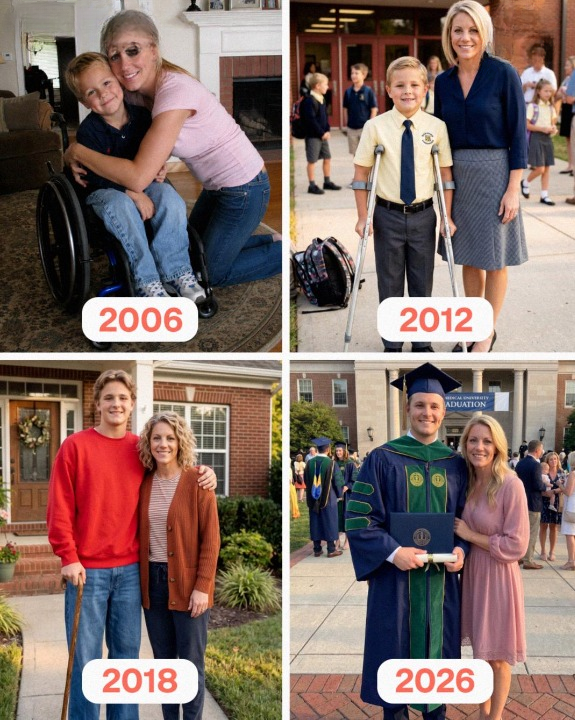
I gave birth believing my marriage would survive anything. I was wrong. The day our son was born, my husband walked out of the hospital without a backward glance, leaving me alone with a newborn and a future neither of us had prepared for. Twenty-five years later, a single public moment forced him to confront everything he had once abandoned.
The day he left didn’t come with shouting or slammed doors. It came with silence.
My son, Henry, was only hours old, still pressed against my chest when the neurologist explained—gently, carefully—that he would face lifelong mobility challenges. I was still trying to process the words when Warren reached for his keys. He didn’t look at his son.
“I’m not doing this,” he said flatly. “I didn’t sign up for this kind of life.”
And then he walked out, as if leaving were the easiest decision he had ever made.
What followed wasn’t a story of heroism. It was survival.
Hospital rooms that smelled of antiseptic. Paperwork I barely understood. Nights spent on the floor beside my baby, stretching his legs while he cried, my exhaustion so deep it felt like part of my bones.
Doctors spoke in careful phrases—“motor impairment,” “adjusted expectations”—as if softer language could soften reality.
But Henry grew. And against every assumption, he fought.
By childhood, he was arguing with doctors instead of fearing them. By adolescence, he was reading medical texts most adults couldn’t navigate. And somewhere along the way, what once looked like limitation began to change.
Therapy became progress. A wheelchair gave way to a cane, then to nothing at all. Not overnight—but steadily, relentlessly.
He earned a place in medical school and rose to the top of his class.
Then, just before graduation, he told me something that made my stomach tighten.
His father had called.
Warren had found out.
And now he wanted to attend the ceremony.
I wanted to refuse for Henry’s sake. But my son made his own choice.
“I invited him,” he said quietly.
Graduation day arrived with lights, noise, and too many eyes. And then Warren walked in—older, confident, acting as if time had simply paused for him instead of continuing without him.
He smiled like he belonged there.
When Henry stepped onto the stage, steady and composed, he looked directly at him.
“Father,” he said, calm but deliberate, “I’ve rehearsed this moment for years.”
And then he began to speak.
He didn’t tell a story of pity or struggle for applause. He told the truth.
About a father who left on the day he was born.
About a mother who stayed through every appointment, every therapy session, every night when exhaustion and fear felt heavier than sleep.
About a life built not on absence—but on persistence.
And then he said something that shifted the entire room.
“If I’m standing here today, it’s not because I overcame alone. It’s because my mother never left.”
The silence that followed was heavy, complete.
Henry turned toward me.
“Everything I am,” he said softly, “learned your name first.”
I couldn’t hold back the tears.
When the applause finally came, it wasn’t for a story of ease or triumph—it was for endurance, for truth, for the life that had been built in spite of abandonment.
And Warren stood there, finally understanding what he had walked away from.
Not just a child.
But a story he no longer had any part in shaping.