
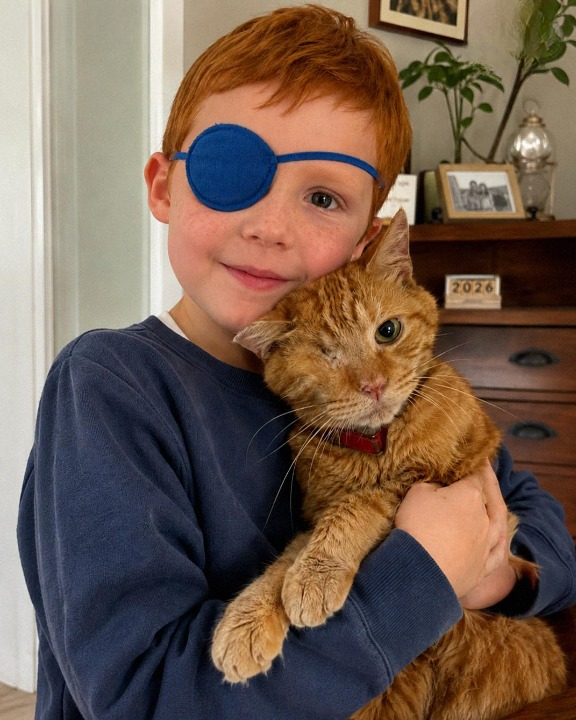
I thought I was just helping my son rescue an injured one-eyed ginger cat left near our mailbox. But when we discovered a hidden note beneath its collar two days later, it became clear someone had chosen our home on purpose—and the reason reached back to a hospital memory I had nearly forgotten.
The late afternoon light spilled through the kitchen while I washed dishes after a double shift, still in my scrubs. My son Noah sat at the table drawing superheroes, as he often did.
“Mom,” he asked, “can a pirate be a doctor too?”
“I think a pirate can be anything he wants,” I replied.
“Even if he only has one eye?”
I turned toward him. His own eye patch covered the place where his left eye had been removed after cancer treatment years earlier. The surgeries, the hospital stays, and the bills still felt close.
“Especially then,” I said.
He nodded quietly, then asked, “Am I ugly?”
I crossed the room immediately and knelt beside him.
“You are the most beautiful thing I’ve ever seen,” I told him. “Don’t ever think otherwise.”
He looked down again, uncertain, and I turned back to the sink so he wouldn’t see my expression.
A little later, the screen door burst open.
“Mom, come quick!”
Noah stood there holding a thin, injured orange cat. One eye was gone, its back leg dragged slightly, and its fur was rough and unkempt.
“I found him by the mailbox,” he said. “He’s like me.”
The cat didn’t resist as I approached. It just watched quietly.
I hesitated. “We should try to find its owner.”
“No,” Noah said firmly. “He needs us.”
After a moment, I agreed. We had little extra money, but I couldn’t ignore the way the cat seemed to trust him immediately.
He named it Captain.
That night, I watched them sleep curled together, both marked by injury in different ways.
The next day, I posted in local groups asking if anyone recognized the cat. One comment stood out: a warning not to let my son “get attached just because they match.”
The word lingered painfully. Noah, meanwhile, treated the cat like it had always belonged.
We scheduled a vet visit.
During the exam, the vet noted recent medical care. Then she removed the collar. Inside, hidden beneath the lining, was a folded note.
I read it once, then again.
It explained that the cat had been left there intentionally. It had belonged to a woman named Marian, and it had been placed at our house for a reason tied to her late son’s wish.
My hands shook as I realized this wasn’t an accident.
That night, I called her.
She explained through tears that her son had met Noah in a hospital pediatric ward years earlier. Noah, wearing his eye patch and pretending to be a pirate, had made her son laugh during a painful time. The two boys had briefly shared a moment of comfort neither of us had fully understood then.
Her son had bonded with a cat he named Benji, inspired by Noah’s courage. Before he died, he asked his mother to find the “pirate boy” and give him the cat.
But fear, grief, and desperation had led her to leave the cat at our house without asking permission first.
She admitted she had watched us from a distance to find us.
I felt anger, confusion, and sadness all at once. But I also understood the depth of her grief.
The next day, I explained part of the truth to Noah in simple terms—that the cat had once belonged to a boy who had cared about him from afar.
“Did he love him?” Noah asked.
“Yes,” I said.
We gave Noah the choice about what to do next.
On the boy’s birthday, Marian invited us to the hospital garden where he had once been treated. Noah agreed, insisting Captain should go too.
When we arrived, she was waiting with drawings and memories of her son. Noah approached her calmly and asked if she was the boy’s mother. Then he placed the cat in her arms for a moment before gently taking it back.
“He comes home with me,” he said, but not unkindly.
Marian nodded through tears.
Later, she publicly apologized for watching us and for leaving the cat without consent. The misunderstanding that had once spread online was corrected.
We left with Captain that day.
As we drove home, Noah rested against the seat.
“Do you think he can see us?” he asked.
“I think he remembers you,” I said softly. “And I think that’s enough.”
Some connections don’t begin in normal ways. Sometimes they arrive quietly, unexpectedly, and change everything you thought you understood about loss, healing, and how people find each other again.