
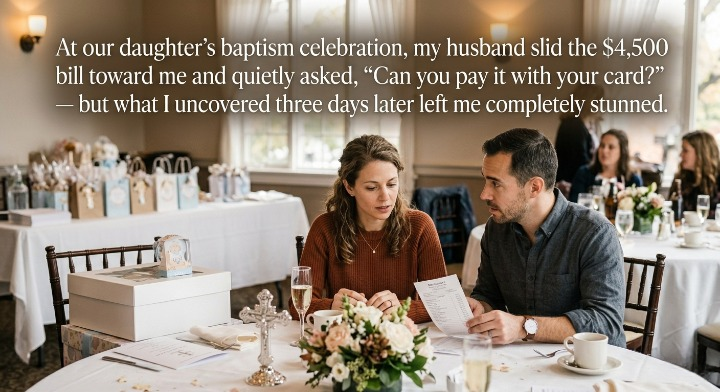
At our daughter’s baptism celebration, my husband quietly slid the $4,500 bill toward me and whispered, “Can you pay it with your card?” I looked at him, then at the invoice, and stayed silent. He had no idea I already knew this party was never really about our daughter.
The banquet hall was filled with guests who all saw Daniel as the perfect husband. Both our families were there, along with his coworkers, all raising glasses and praising him as a devoted father. The room was decorated with balloons, flowers, and a banner for our baby Lily. Everyone kept telling me how lucky I was.
I sat at the head table, smiling politely, with proof hidden in my handbag that no one noticed. Every compliment made the air feel heavier, not lighter.
Midway through the event, Daniel stood and tapped his glass to make a speech. He thanked everyone, spoke about hard work and family, and then turned to praise me as the mother of his child. The room applauded warmly. His mother wiped away tears. People looked at me as if I had something to celebrate.
But three months earlier, everything had already changed.
I had come home early one rainy afternoon and found his computer still on. A locked Messenger conversation caught my attention. After a few guesses, I opened it. The name on the screen was Chloe—his former girlfriend.
The messages revealed a second life: Chloe was pregnant, and Daniel had been attending her appointments, sending her money, and promising support. He had described our marriage as broken and called her the most important person in his life. Over the following weeks, I discovered bank transfers totaling thousands of dollars—money he claimed we couldn’t spare for our own child.
I didn’t confront him. I saved everything: screenshots, recordings, bank records. Then I met a lawyer and began preparing quietly.
For weeks, I acted as though nothing had changed. I smiled, cooked, and played the part of the trusting wife while legal steps moved forward in silence.
Then came the baptism.
Daniel had arranged the celebration not just for our daughter, but for appearances—carefully curated to present himself as the perfect family man. I realized he planned to use my card to cover the cost.
As the night ended, he slid the bill toward me again. “Can you pay it?” he whispered.
I looked at him, then at the table full of guests, and calmly pushed the bill back.
“This isn’t my party to pay for,” I said.
His expression faltered.
I continued evenly. “I know about Chloe. I know about the money. I know everything.”
The table fell silent as I explained that legal proceedings had already begun, the account was frozen, and the truth was documented.
Then I stood, placed a small framed photo of Lily on the table, and said, “This is for my daughter—who deserves a real celebration someday.”
And I left.
Behind me, I heard the shift in the room, but I didn’t turn back.