
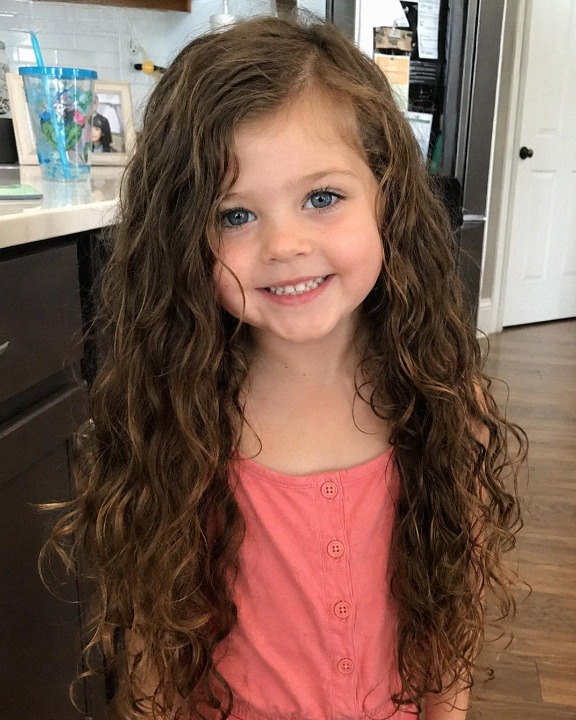
I took my 4-year-old daughter for a simple haircut, but she panicked and cried that her father would not recognize her when he came back. My husband had been gone for years, and what she said led me into a truth that changed everything I thought I knew about my family.
My daughter didn’t react at first. She sat quietly while Clara combed through her curls, the salon cape wrapped around her like a costume. She even smiled when the chair spun once and the hairdresser tried to lighten the mood.
But the moment the scissors opened, everything changed.
She screamed and grabbed her hair. “No! Mom, please!”
The room went silent.
I knelt beside her, trying to calm her down. “It’s just a trim, sweetheart. Nothing is going to happen to your hair.”
But she kept shaking her head, tears streaming down her face. “Daddy won’t know me!”
Clara stopped mid-motion, scissors still in her hand. My stomach tightened.
My husband, William, had died three years earlier. Olivia was only a year old when it happened. She knew him only through stories and photos I had kept carefully for her.
So hearing her speak like he was still coming back didn’t feel like imagination or grief. It felt like something had been planted.
I took her home instead.
In the car, I asked her gently why she thought her father would not recognize her. She hesitated, then finally said something that made my chest go cold: her grandmother had told her that her curls were how he would find her.
At home, I asked more questions. The answers stayed the same. According to Olivia, her grandmother insisted her father was still “coming back,” and that changing her hair might make him not recognize her.
That night, I opened her backpack.
Inside was a drawing of a man standing beside a house with Olivia and her grandmother. On the back was a photo of William holding her as a baby, along with a handwritten note: Don’t forget who you belong to.
That was when I realized this wasn’t just confusion. Someone had been shaping her fear.
The next day, I contacted the lawyer handling William’s estate. I learned that my mother-in-law had been asking questions about challenging custody and even suggested I was unstable. She had also been trying to use Olivia’s emotional state as evidence.
I confronted her in person.
At first, she acted like I was overreacting. But when I showed her the drawing and the note, her explanation fell apart. What came out instead was years of unresolved grief, jealousy, and the inability to accept William’s death. In her mind, preserving his memory had turned into controlling how his daughter experienced him.
But Olivia wasn’t a memory. She was a child.
Legal steps followed. Documentation from the salon, from a child therapist, and from the estate lawyer all supported what had been happening: Olivia’s fear had been reinforced by an adult, not created by her.
In mediation, the truth was laid out clearly. My mother-in-law had been projecting her grief onto my daughter and building a narrative that kept William “alive” in a way that was emotionally harmful.
The outcome was supervised visits and clear boundaries—no more discussions about William returning, no more emotional pressure placed on Olivia, and no interference in her upbringing.
A month later, Olivia asked for another haircut. This time, there was no fear. She sat in the chair, held my hand, and chose what she wanted without panic.
When it was done, she looked at me quietly and asked if she still looked like herself.
I told her the truth: more than ever.
That night, we placed a small lock of her hair in William’s memory box—not as something tied to fear, but as a reminder that love doesn’t depend on staying frozen in time.