
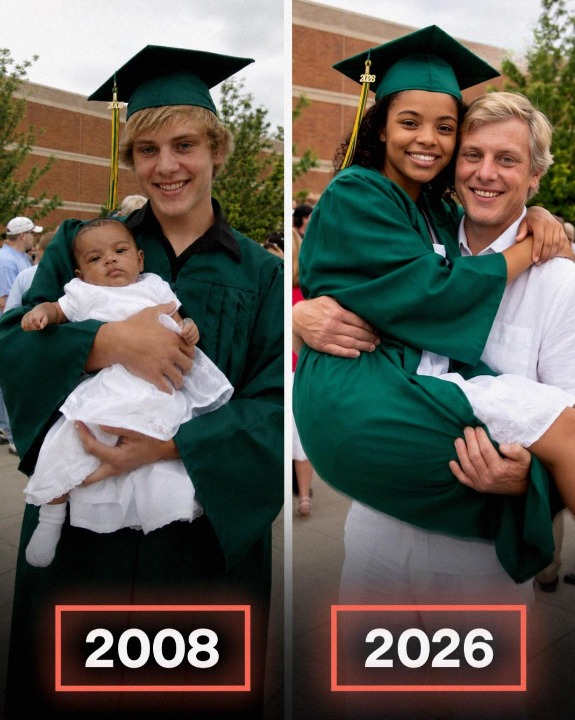
The only photograph that has ever hung in our home shows a terrified teenage boy on a graduation field, holding a three-month-old baby wrapped in a blanket—me.
My dad has always joked about it. “I survived that day,” he once said, looking at the cracked frame. “I can survive anything.”
He was seventeen when he found me.
He came home after a late shift delivering pizzas and saw his old bike outside the fence. In the front basket, there was a bundle wrapped in a blanket. At first, he thought it was trash.
Then it moved.
Inside was a baby girl. Me. Three months old, crying, with a note tucked beside me:
“She’s yours. I can’t do this.”
He had no idea my birth mother was even pregnant. No warning. No explanation. Just a baby left behind.
And instead of walking away, he picked me up.
The next morning was his graduation ceremony. Most people would have panicked or called social services. He didn’t. He wrapped me tighter in the blanket, took his cap and gown, and walked into the ceremony holding both.
That’s the photo.
He gave up college, worked construction, delivered pizzas at night, and learned how to raise a child through trial and error—braiding my hair from bad tutorials, packing lunches, showing up every single day so I never felt abandoned.
To me, he was my whole world.
So when I graduated eighteen years later, I brought him with me.
We walked across the same field where that old photo was taken. He tried to act strong, but I could see how emotional he was.
Then everything changed.
A woman stood up from the crowd during the ceremony. She stared at me like she’d been searching for me her entire life.
And then she walked forward.
Before I understood what was happening, she pointed at my dad.
“That man is not your father,” she said.
The words hit like a shockwave. I looked at him, confused, waiting for him to deny it.
But he didn’t speak right away.
She claimed she was my mother—that I had been taken from her. The crowd erupted in confusion and whispers.
My dad finally stepped forward, shaking his head.
“I didn’t steal her,” he said quietly. “But I’m not her biological father.”
He explained that my birth mother had left me with him when I was a baby, promising to return. She never did. He raised me because there was no one else.
The woman insisted she had come back for me. Voices from the crowd began to contradict and confirm pieces of the story, until even a teacher from years ago stepped forward and confirmed the truth: I had been left behind, and my dad had been the one who stayed.
The woman—my biological mother—then revealed something else. She was sick. Leukemia. She needed a bone marrow match. I was the only possible donor.
The crowd went silent.
She begged me to help her.
My dad didn’t tell me what to do. He just said he would support whatever I chose.
And in that moment, I realized something: he had already shown me everything I needed to know about who I am.
So I agreed to get tested—not because she had suddenly become my mother, but because the man who raised me taught me to do what’s right, even when it hurts.
As we left the field together, the principal called for the only person who should walk me across the stage.
It was him.
We stepped forward side by side, just like we had eighteen years ago in that photograph.
Because family isn’t defined by who leaves you.
It’s defined by who never does.