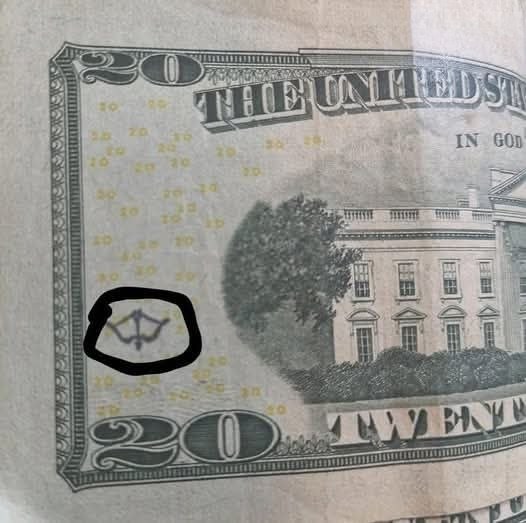
If you’ve ever looked closely at a U.S. dollar bill under good lighting, you might have noticed small, unusual marks—tiny symbols like bows and arrows, stars, letters, or geometric shapes that don’t appear to be part of the official design. At first, these markings can seem strange or even suspicious, as if the bill contains some hidden message or secret code.
In reality, these marks are known as “chop marks.” They are not random or official U.S. printing features, but stamps added by currency handlers, traders, and merchants—mostly in international markets—who regularly deal with cash.
In many parts of the world where U.S. dollars circulate heavily, counterfeit money is a serious concern. To reduce the risk of accepting fake bills, experienced money handlers carefully inspect currency by checking security features such as paper texture, watermarks, and printing details. Once they confirm a bill is genuine, they may stamp it with a small personal symbol. This mark signals to others in the trade that the bill has already been verified as authentic.
The practice has deep historical roots. Long before modern banking, merchants in parts of Asia used similar stamping systems on coins and silver to confirm purity and authenticity. Over time, as paper currency replaced coins in global trade, the same habit carried over to banknotes.
Because the U.S. dollar is widely used around the world, it is one of the most frequently stamped currencies. A single bill can pass through many countries, markets, and exchanges over its lifetime, collecting multiple chop marks along the way—each one representing a point where someone trusted and verified it.
In the United States, these marks do not make the bill illegal or invalid. As long as the currency is not damaged to the point of being unusable or altered in a way that hides key details, it remains legal tender. Chop marks generally do not affect serial numbers, denomination, or security features, so the bill is still fully accepted by the government.
However, they can sometimes cause minor issues in daily use. Certain machines like self-checkouts or vending systems may reject marked bills, and some cashiers may take extra time to inspect them if they are unfamiliar with chop marks.
Despite that, these markings do not reduce the actual value of the money. Instead, they quietly reflect the bill’s journey through different parts of the world. What once looked like a strange symbol is actually a small trace of global trade history—evidence that the bill has been handled, trusted, and passed across cultures before ending up in your hand.