
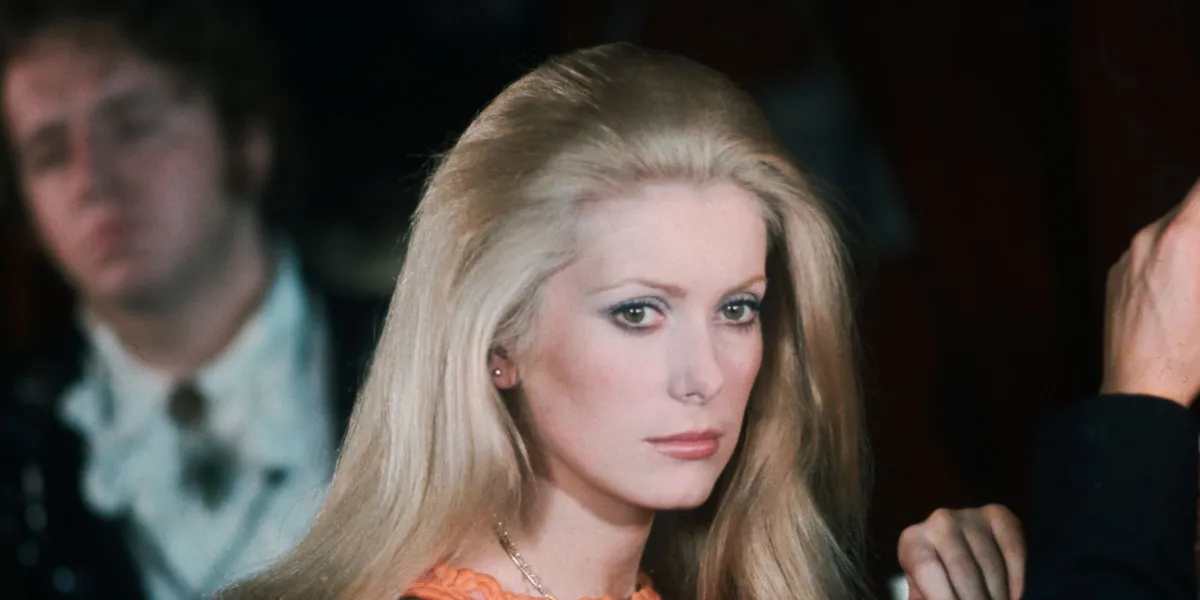
She stepped onto one of the most watched red carpets in the world—and for a moment, all eyes were on her.
There’s a woman who has spent over six decades at the very top of global cinema, and she’s still going strong.
She currently has two films featured at the 2026 Cannes Film Festival, including *Histoires Parallèles (Parallel Tales)*, directed by Asghar Farhadi, alongside Isabelle Huppert and Vincent Cassel, as well as *Gentle Monster*, where she plays the mother of Léa Seydoux.
Despite her legendary status, she remains humble, saying even the smallest roles must have meaning. What matters most to her is the vision of the director—especially younger filmmakers bringing fresh energy and ideas.
### Still at the Top
She made her film debut in 1957 as a teenager, taking on small roles before her breakthrough came in 1964 with *The Umbrellas of Cherbourg*, directed by Jacques Demy. The film won the Palme d’Or at Cannes and instantly turned her into an international star.
From there, she took on bold and complex roles, including in *Repulsion* (1965) by Roman Polanski, *Belle de Jour* (1967) by Luis Buñuel, and *The Last Metro* (1980) by François Truffaut. In 1992, *Indochine* earned her an Academy Award nomination.
She continues to return to Cannes—not for farewells, but as a reminder of the legacy she built there and continues to carry forward.
### A Complex and Uncompromising Figure
Over the years, she has portrayed everything from troubled characters to unconventional roles, yet she has always maintained clear personal boundaries—especially when it comes to nudity in film, believing it can take away from the character.
Her public image has never been simple. She has spoken out on major social issues, supported political causes, and also sparked debate with some of her views. She remains a figure who resists easy labels.
### A Lifelong Passion for Cinema
What has never changed is her love for film. She still enjoys the experience of cinema and continues working with the same passion. At the same time, she has noted how filmmaking has evolved—becoming faster and less collaborative than it once was.
### Still Captivating Audiences
At a recent Cannes premiere, she appeared in an elegant, understated outfit that reflected her timeless style. Fans quickly praised her appearance, calling her as radiant and captivating as ever.
Her name is Catherine Deneuve—born in Paris in 1943 and widely regarded as one of the greatest figures in French cinema.
More than just a film icon, she was chosen in 1989 as the face of Marianne, the symbol of the French Republic. Decades into her career, she remains not just part of cinema history—but a living legend.