
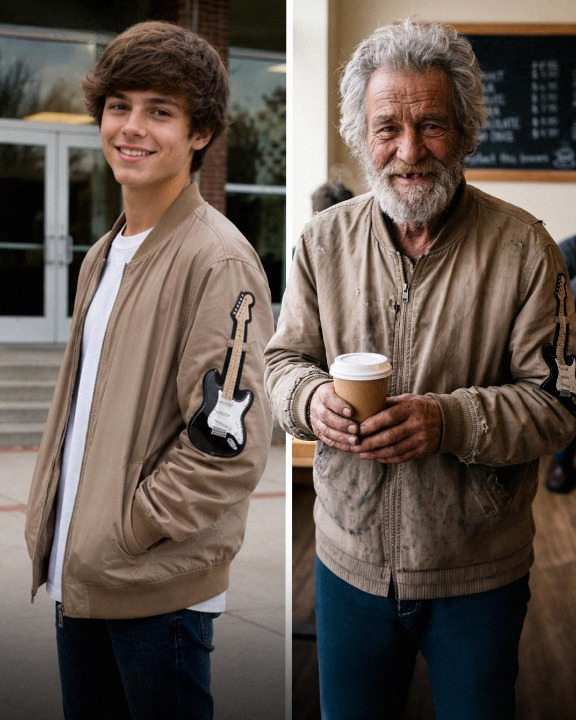
ALMOST A YEAR AFTER MY 16-YEAR-OLD SON DISAPPEARED, I SAW A HOMELESS MAN IN A CAFÉ WEARING HIS JACKET — THE SAME ONE I HAD REPAIRED MYSELF. WHEN HE SAID A BOY GAVE IT TO HIM, I FOLLOWED HIM TO AN ABANDONED HOUSE… AND WHAT I FOUND THERE COMPLETELY SHATTERED EVERYTHING I BELIEVED ABOUT MY SON’S DISAPPEARANCE.
The last time I saw Daniel, he was in the hallway tying his shoes, backpack slung over one shoulder like any normal school morning.
“Did you finish your history assignment?” I asked.
“Yeah, Mom,” he replied, kissing my cheek before heading out the door. “See you tonight.”
But he never came back.
At first, I didn’t panic. Daniel was responsible—kind, thoughtful, always texting me if he stayed late with friends or went somewhere else. I kept telling myself he’d just lost track of time.
But as night fell and his room stayed empty, fear slowly took over. I called his phone. Straight to voicemail.
By late evening, I was driving around looking for him. By midnight, I was at the police station reporting my own child missing.
The officer suggested he might have “just left for a while,” like teenagers sometimes do. But I knew Daniel. He wasn’t that kind of boy.
The next day, I went to his school and asked to see the security footage. I watched him leave with a girl named Maya—quiet, withdrawn, someone he had spoken about a few times. They walked to a bus stop together and got on a bus. After that, there was nothing.
When I went to ask about Maya, I learned she had suddenly transferred schools. At her home, her relative was distant and evasive, refusing to give me real answers.
Then came months of searching. Flyers. Social media posts. Police updates that slowly faded as the case went cold. Eventually, everyone started using one word: runaway.
But I never believed it.
Almost a year later, while traveling for work, I stopped at a small café. That’s when I saw him.
An elderly homeless man walked in, counting coins in his hand—and he was wearing Daniel’s jacket.
Not a similar one. The exact one.
The torn sleeve I had patched with a guitar-shaped fabric piece. The paint stain on the back that never came out. It was unmistakable.
I paid for his drink and approached him, my voice shaking as I asked where he got it.
“A boy gave it to me,” he said simply.
A boy.
I tried to get more details, but he slipped out before I could press further. I followed him without thinking.
He walked for miles, never stopping to eat or drink, moving with purpose toward the edge of the city. Eventually, he reached an abandoned house surrounded by overgrown weeds.
He knocked.
I hid nearby, my heart pounding, watching as the door opened.
And then I saw him.
Daniel.
Alive.
But before I could reach him, he saw me—and ran.
I chased him through the house and out into the woods, but I lost him again. Devastated, I went straight to the police, desperate for answers.
Later that night, they told me they had found him near a bus terminal.
When I finally saw him in an interview room, he wasn’t alone in a criminal sense—he was terrified.
And then he told me the truth.
Daniel hadn’t run away. He had followed Maya because she was scared of her home life. She had confided in him that her stepfather was volatile and dangerous, and she didn’t believe anyone would help her. On the day she planned to leave, she told Daniel. He couldn’t let her go alone.
So he went with her.
They stayed hidden together, moving from place to place, while Daniel kept his location secret out of fear that Maya would be forced back into a dangerous situation.
The old man I saw in the café? Daniel had given him the jacket intentionally—hoping that if anyone recognized it, it might lead me to him without breaking his promise to Maya.
In the end, police located Maya as well. She was placed into protective care, and the situation that had driven them into hiding was finally investigated.
Weeks later, I stood in my living room watching Daniel and Maya sitting safely on the couch, watching a movie like normal kids, a bowl of popcorn between them.
My son hadn’t abandoned me.
He had protected someone else when no one else would.
And somehow, through everything, he had found a way to leave a trail back home.