
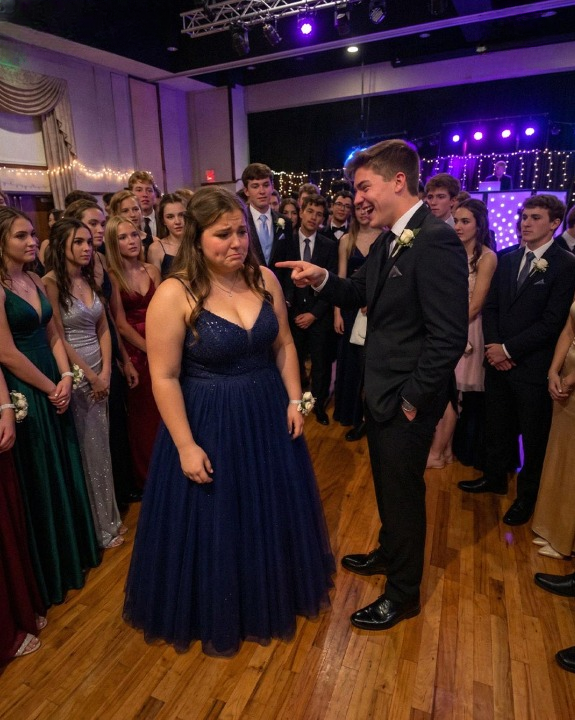
After donating my kidney to save my mother’s life, I gained weight during recovery. By prom night, the entire school had decided my changed body made me a target. Still, I showed up in a dress I’d altered again and again, hoping for at least one decent memory — but instead, the night turned into the most humiliating moment of my life on the dance floor.
My mom helped me zip up the back of my dress with hands that were still too fragile from her own illness.
Six months earlier, those same hands had been weak against a hospital blanket while doctors told us her kidneys were failing and time was running out.
I didn’t hesitate. I said yes immediately when I learned I could donate mine.
Back then, it felt straightforward — love usually does when you’re asked to prove it. It’s the aftermath that changes everything.
Recovery hit me hard: medication, swelling, exhaustion, constant hunger, and a body I no longer recognized. I had once been an athlete. Then I became someone who struggled just walking across a room.
My mom looked at me gently. “You are the most beautiful girl in that school.”
“Then why do I feel like I shouldn’t even go tonight?” I asked.
She fixed a loose strand of my hair. “Because you’ve been listening to people who have never done anything meaningful with their lives.”
I tried to believe her.
My dress barely fit despite multiple alterations, but I still wanted the night to mean something.
She drove me to prom herself.
The ride took me past old memories — the track where I used to run, the gym where I’d recently started rebuilding my strength after everything changed.
That’s where I met Mr. Stallone — my trainer. Quiet, direct, and not easily impressed.
After one difficult session, I finally told him enough of my story for him to understand: my mom’s illness, the transplant, the medication, the weight gain, the whispers at school.
He listened carefully, then said something I didn’t forget:
“You saved a life. Don’t let anyone make you ashamed of the body that did it.”
But school was still school.
Even Jaxon — the boy I had liked for years — joined in the jokes once, laughing with his friends while I pretended not to hear.
I told myself prom might still give me one good memory.
When I arrived, the gym looked like something out of a movie — lights, decorations, music, everyone dressed up and pretending life was bigger than it really was.
For a brief moment, it felt magical.
Then the whispers started.
Then the looks.
Then the laughter.
Even my friends hesitated when they saw who was nearby.
And then Jaxon walked toward me.
He smiled — not the cruel one I was used to, but something that looked almost real.
“Hey,” he said. “You want to dance?”
I hesitated, confused, but I still said yes.
We went to the center of the floor, and for a moment, I actually felt hopeful.
Then he leaned in close enough for everyone to hear and said:
“Are you serious? You really thought I’d be seen with you?”
The words hit like a shockwave.
Then came the laughter.
“Look at you,” he added. “You’re a joke.”
The room followed his lead.
I stood frozen, humiliated, unable to move as the world around me turned cruel.
Then suddenly — the gym doors slammed open.
Everything stopped.
Mr. Stallone walked in.
Jaxon’s face immediately changed.
Fear.
Real fear.
Mr. Stallone didn’t raise his voice, but the entire room went silent anyway.
“Step forward,” he told Jaxon.
Jaxon tried to laugh it off, but it didn’t work.
Mr. Stallone pulled out a stopwatch.
The moment Jaxon saw it, he understood.
He was in trouble.
“You have five minutes,” Mr. Stallone said, “to fix what you just did.”
Panic set in immediately. Jaxon rushed toward me, suddenly desperate.
“It was a joke,” he said quickly. “Come on, just dance with me.”
I looked at him and realized the truth — he wasn’t sorry for me. He was afraid of losing something.
So I said no.
Then everything shifted.
Mr. Stallone explained who he really was — a league scout connected to Jaxon’s future opportunities.
The stopwatch wasn’t random.
It was a test.
And Jaxon had failed.
Then Mr. Stallone turned to the room and told everyone watching that tearing someone down like that says more about them than it ever will about the person they target.
After he left, silence filled the gym.
Then something unexpected happened.
People started apologizing.
And then the music started again.
I danced alone at first — just trying to exist in my own body without shame. Then others joined me. Slowly, the room changed.
Not because I changed — but because the atmosphere did.
By the end of the night, I wasn’t hiding anymore.
My mom picked me up later and asked how it went.
I smiled and said, “Memorable.”
She understood enough to hold my hand tighter.
Jaxon later sent an apology. I never replied.
Some people lose access to you the moment they turn your pain into entertainment.
And I learned something too — the body that saved a life doesn’t owe anyone an apology.