
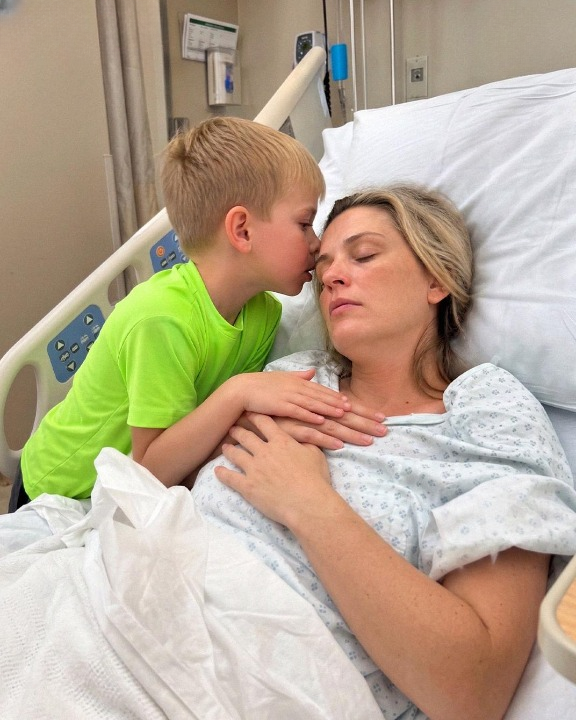
The first flickers of awareness felt delicate, like everything might break if I moved too soon. So I stayed still—and in that quiet, the truth began to reveal itself.
The sound that pulled me back was a steady beeping, cutting through the darkness like a signal from far away. My body felt heavy and unresponsive. I couldn’t move or open my eyes, but I knew I was awake.
Then I felt a small, trembling hand slip into mine.
“Mom… if you can hear me… don’t open your eyes.”
It was my eight-year-old son, Bruce.
My heart raced, but I forced myself to remain still.
He leaned closer, his voice shaking. “You need to listen to what Dad is planning… please. Just pretend you’re still asleep.”
Something in his tone made me trust him instantly, even without understanding why.
So I didn’t move—even as fear started creeping in.
Moments later, the door opened. I heard two sets of footsteps: my husband, Arthur, and my sister, Chloe.
“Are you sure she’s still unconscious?” Arthur asked, his voice cold and impatient.
“The doctor said she won’t wake up,” Chloe replied casually.
Then I heard it—a soft kiss.
My stomach tightened.
“Good,” Arthur said. “Everything’s falling into place.”
My pulse quickened.
What did that mean?
“Once they take her off life support, it’s over,” Chloe added. “No one will question it.”
Bruce’s grip tightened in mine.
“We just have to be careful,” Arthur continued. “No mistakes.”
Then Chloe asked quietly, “And the boy?”
I froze.
Arthur answered without hesitation. “We’ll follow the plan for Bruce.”
My son’s hand began to shake.
I fought every instinct to react.
I heard papers rustling, a bag unzipping near the bed.
“Is that everything?” Chloe asked.
“Insurance confirmation, updated beneficiaries, and the boarding school forms,” Arthur said. “It’s all ready.”
Boarding school?
“Once she’s gone, everything moves quickly,” Chloe said.
Gone?
It hit me then—they weren’t just waiting for me to die. They were planning it.
When the doctor entered, Arthur smoothly suggested withdrawing care, presenting outside recommendations about my “low chance of recovery.” Thankfully, the doctor hesitated, suggesting they wait.
Arthur played along, pretending hope—but I knew better.
In that moment, I realized something else: he didn’t think Bruce mattered. He assumed our son wouldn’t understand or speak up.
He underestimated him.
But I didn’t.
As soon as the room cleared, I gathered every bit of strength I had and managed to move slightly.
“Mom?” Bruce whispered.
I forced out a weak response. “Listen… we don’t have much time…”
I told him to take photos of the documents and bring them to me the next day—carefully, without getting caught.
He agreed without hesitation.
That night, I stayed still, thinking. My husband and sister weren’t just planning my death—they intended to remove Bruce from the picture too.
By morning, I knew what I had to do.
When Bruce returned, he whispered, “I got them,” while pretending to kiss me.
I stayed still until Arthur, Chloe, and the doctor were all present again.
Arthur began speaking about letting me go.
That’s when I opened my eyes.
Silence filled the room.
“I heard everything,” I said weakly but clearly. “I want to speak to my lawyer.”
Arthur tried to regain control, but it was too late.
My lawyer arrived quickly. Bruce bravely explained what he had heard and showed her the photos. The documents confirmed everything—plans, signatures, even questionable medical recommendations.
Soon after, I was stabilized and moved out of intensive care.
As we dug deeper, a disturbing pattern emerged. I had been growing weaker for weeks—after my husband began preparing my drinks. Bruce recalled how Arthur would refuse to let him taste them.
Tests revealed traces of a substance—something administered in small amounts over time, enough to impair me without immediate detection.
It wasn’t an accident.
It was deliberate.
From that point on, everything unraveled. My husband was blocked from contacting me, and the investigation began. My sister was tied to the planning through the paperwork.
Days later, I was strong enough to sit up. Bruce stayed by my side.
“You were so brave,” I told him.
“I was scared,” he admitted.
“I know. But you still acted—and you saved me.”
He looked at me quietly. “Are we going to be okay?”
I took his hand.
“Yes. We are.”
Not because everything was fixed—but because the truth was out, and we weren’t alone anymore.
A few days later, I was discharged. Recovery would take time, but I was alive.
And as Bruce slipped his hand into mine, steady and warm, I knew we had made it through the worst.