
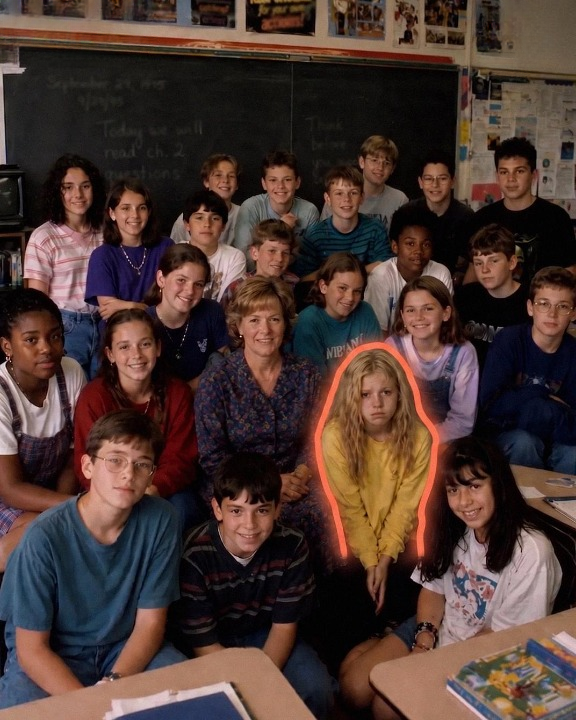
I returned to my old school with twelve small brown paper bags and memories I’d never quite grown out of. Years ago, a handful of classmates had quietly shared their food with me when I had nothing—never making me feel lesser for it. Others hadn’t been so kind. Now I was coming back, and I knew it was time to face what all of it had meant.
I was thirty-seven, sitting in a rental car outside the same high school I once ran through as a starving kid, now dressed in a blazer that cost more than my mother used to earn in a week. My hands still trembled on the steering wheel.
“You run a company with hundreds of employees,” I told myself. “You can walk into a cafeteria.”
But the moment I saw the side entrance—the rusted handle, the familiar brick wall—everything in me tightened.
For a second, I wasn’t an executive. I was twelve again: hungry, unnoticed, surviving lunch periods I couldn’t afford.
Then I saw her.
A small girl sitting alone in the cafeteria, watching everyone else eat.
I recognized that look immediately.
That was my sign.
I stepped out of the car and took the bags with me.
When I was a child, I was the quiet one—the “soft” kid teachers didn’t know how to talk about without mentioning hunger. My father left when I was ten. My mother worked herself into exhaustion, and there were nights when dinner simply didn’t exist.
At school, I learned where to disappear: the bathroom, the library, anywhere hunger hurt less in silence.
But a few kids noticed anyway.
One boy, Dylan, once slid half his sandwich across the table like it was nothing. Another girl, Tessa, pretended she didn’t like her cookies every Thursday—just so she could leave them behind. Nina slipped food into my pockets when no one was looking. Caleb sat beside me when others tried to isolate me. Sofia shared what little she had without ever making it feel like charity.
They never made a scene about it. That was what made it kindness.
But there were others too—like Brett—who made sure I never forgot what humiliation felt like.
I left town at eighteen on a scholarship, carrying almost nothing but survival instincts and the belief that I would never be powerless again. Years later, I built a company that helped feed children like the one I used to be.
That’s what brought me back.
The school had invited me to propose a new meal program. I agreed—but the real reason I came was in those twelve paper bags.
Inside, I saw familiar faces again. Dylan. Nina. Caleb. Even Tessa’s daughter, Lily. Each one tied to a memory I had never stopped carrying.
And then there was Brett.
Older now, polished, comfortable in authority—the kind of man who had never questioned whether he deserved it. He didn’t even recognize me at first.
The meeting began with numbers and policies. I let it all pass.
Then I stepped forward with a single brown paper bag.
I told them the truth: about hunger, about hiding, about what it meant to be fed without shame—and what it meant to go without it.
One by one, I reminded them of moments they had forgotten but I never had.
A sandwich shared. A cookie left behind. A place saved at a table.
And then I looked at Brett.
He tried to dismiss it all as sentiment. But the room wasn’t listening anymore.
Because this wasn’t just about food policy.
It was about who had been seen—and who had been ignored.
I handed out the bags.
Inside each one was something different: a memory made tangible, a truth returned to its owner, a reminder that small kindnesses last longer than anyone realizes.
When I gave Brett his, he opened it expecting nothing.
Instead, he found the past he had tried to bury—along with a message he couldn’t laugh off anymore.
The room went silent.
And for the first time, he had nothing to say.
After the meeting, messages started coming in. Gratitude. Apologies. Recognition. People I hadn’t spoken to in years suddenly remembering what we had shared.
But the most important thing wasn’t the reaction.
It was what came next.
A new program was approved. A “no-shame” meal system for students who needed it, no questions asked.
And when the first child walked into that cafeteria and took a meal without fear, I understood something I hadn’t when I was twelve:
Those small brown paper bags had never just been about food.
They were about being seen—and making sure no one else had to go invisible just to survive.