
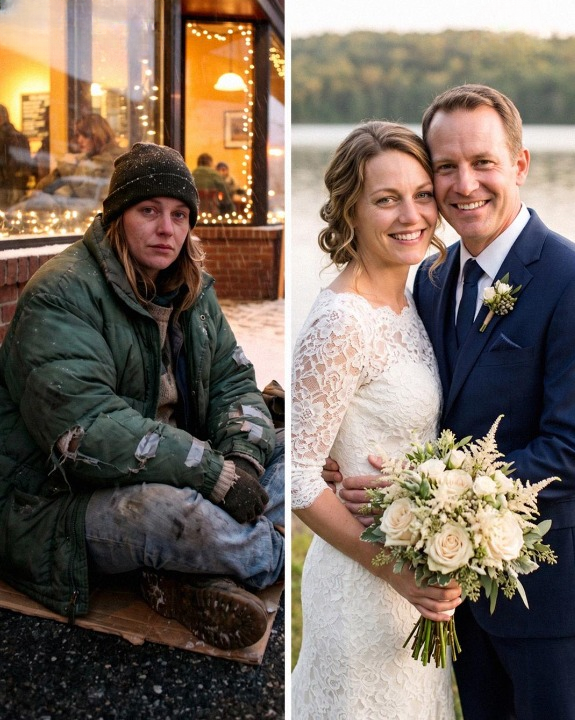
I rebuilt my life after losing my wife and daughter, and just when I thought I had finally found peace, one quiet moment on my wedding night showed me the past was far from over.
I never imagined I’d marry again.
Fifteen years ago, I lost my wife, Hannah, and our four-year-old daughter, Sophie, in a car accident. Hannah was thirty-two. I survived—and for years, that felt less like luck and more like a mistake.
I kept going, but only mechanically. I wasn’t strong. I was simply organized. I worked, nodded when people praised my strength, and buried myself in routine.
In my hallway closet, I kept a box filled with everything connected to the crash: police reports, insurance papers, medical notes, legal documents. I read them so often I memorized entire pages.
Then, nearly two years ago, on a freezing January night, I saw a young woman sitting outside a coffee shop, warming her hands with her breath while people passed by as if she didn’t exist.
I stopped.
“Are you okay?” I asked.
She looked up slowly. “Depends who’s asking.”
“Someone with a car and terrible instincts.”
That earned the faintest smile.
She looked to be in her early twenties—thin coat, tired eyes, shivering.
“Have you eaten?”
“Not today.”
“Come inside. I’ll buy you something hot.”
She studied me for a moment, then stood. “If you get weird, I bite.”
Inside, she ate soup and half a sandwich before finally relaxing enough to finish the rest.
Her name was Lily—or at least that was what her state ID said. She told me she remembered almost nothing before age seven or eight: hospitals, social workers, being shuffled from place to place. Later, someone at a group home told her records had been lost and no one was coming for her.
“The state used Lily on my file,” she said. “So I guess that’s who I am.”
I asked if she had anywhere to sleep.
“That depends how generous the shelter is tonight.”
I took her home, showed her the guest room, pointed to the lock, gave her a towel, and said, “You owe me nothing. I’ll be on the couch.”
The next morning, she had folded my blanket and washed her mug.
“You don’t need to earn breakfast,” I told her.
Something in her face changed, as if no one had ever said that before.
We became friends.
Over the following months, I helped where I could, but she did the hard work herself. She replaced documents, got a part-time job at a bookstore through a friend of mine, saved money, rented a tiny apartment above a bakery, and slowly built a real life.
She was dryly funny, talked to stray cats like coworkers, hated pity, loved old movies, cheap coffee, and crossword puzzles she never quite finished.
Eventually, I realized I was waiting for her texts.
One night, almost a year after we met, she looked around my kitchen and said, “You know what your problem is?”
“I have several. Pick one.”
“You make being lonely look respectable.”
I laughed harder than I had in years.
Nothing happened between us until long after she was stable and independent. By then she was twenty-three, and I was old enough to know better than to lie to myself.
One rainy night, she came over because her apartment ceiling was leaking. I handed her a towel. As she dried her hair, she said softly, “You always look at me like I matter.”
Before I could think, I answered: “You do.”
She kissed me.
I loved her slowly after that. Then all at once.
Last fall, I proposed.
She stared at me for three seconds. “You realize I come with mystery paperwork and emotional damage?”
“Same,” I said.
She laughed, cried, and said yes.
We married two weeks ago at a small house by a lake. For the first time in fifteen years, I thought life might finally be finished punishing me.
That night, we came home exhausted and happy. She went to change while I used the bathroom down the hall.
When I came back, she had her back to me and was unzipping her dress.
That’s when I saw the birthmark.
Small. Dark. Just below her left shoulder blade.
I froze.
Most of the surviving passenger’s details in the old crash files had been redacted. I never knew her name—only that she was a teenage girl, around nineteen. One medical note used to confirm identity read: distinct birthmark below left shoulder blade.
I had read that line so many times I could still see it in my mind.
Looking at Lily, I heard myself whisper, “Oh my God… it’s you.”
She turned sharply. “What?”
“Liam,” she said. “Why are you looking at me like that?”
I sat down because my legs stopped working.
“I know that birthmark.”
Her face tightened. “From where?”
I swallowed hard. “From the crash that killed Hannah and Sophie.”
Silence.
Then she whispered, “What are you saying?”
“I think… you were in the other car.”
She went pale.
“No.”
“You told me you don’t remember—”
“Not like that,” she snapped.
I said quietly, “I need to know for sure.”
That was our wedding night.
I sat until sunrise with the old case files spread around me.
When she came out, eyes red and arms folded, she said one word. “Talk.”
So I did. I told her everything—how I’d spent years hating a family I never met because rage was easier than grief.
When I mentioned the surviving passenger, she sat down hard.
“That was me?”
“I think so.”
She looked sick. “Did I do something?”
That question made me hate myself.
I reopened the investigation. Through a retired investigator, an old nurse, and buried records, the truth slowly emerged.
Lily had been in the back seat, seatbelt on. Severe concussion. Broken arm. Cuts to the face. Her mother, Dana, had alcohol in her system. Witnesses said she’d been drifting over the line before the curve. She hit black ice, crossed into Hannah’s lane, and everything ended there.
Dana died at the scene.
Lily survived, but her records became chaos—different last names, temporary admissions, transfers, split county files, foster care, group homes, lost follow-ups. Bureaucratic neglect stole her life before she even understood it.
None of it was her fault.
When I told her, she stood so fast the chair scraped backward.
“So I married the man whose wife and daughter my mother killed.”
“You are not your mother,” I said.
She laughed once, bitterly.
“You got to remember what happened to you. I get a blank space and a body count.”
I stepped closer. “Lily, look at me.”
She did.
“You did not kill Hannah. You did not kill Sophie. You were seven years old in the back seat.”
She covered her mouth and cried. At first rigid with shock, then collapsing into me.
She moved back to her apartment for a while. We started counseling.
When the therapist asked what we feared most, Lily answered first.
“That one day he’ll look at me and only see the crash.”
Then my turn.
“That she’ll look at me and only see the man who almost blamed her.”
One night after counseling, she asked quietly, “When you saw the birthmark, what did you feel first?”
I told the truth.
“Rage.”
She flinched.
“And then terror. Because it was you.”
A week later, she asked the harder question.
“When you look at me now, who do you see?”
I took too long. She said, “Don’t lie just to make it prettier.”
So I didn’t.
“Sometimes I see that night first. Then I see you. And I choose to stay here—with you—instead of back there.”
She nodded slowly. “Okay. I can work with honest.”
Yesterday, she came with me to Hannah and Sophie’s graves. We stood there in cold wind and silence. Lily cried before I did.
Then she said softly, “I know I’m not the reason they’re here. But I’m one of the only people left who still carries that night.”
I looked at her—not the file, not the birthmark, not the wreckage.
My wife.
I took her hand.
For the first time in fifteen years, I said out loud, “I’m ready to stop carrying hate like it’s all I have left of them.”
We are still married.
Not in the easy way. In the honest way.
The kind that comes after the truth tears everything open—and neither person walks away.
I don’t believe love fixes everything. That’s something people say when they want pain to sound simple.
I believe love tells the truth.
And stays.