
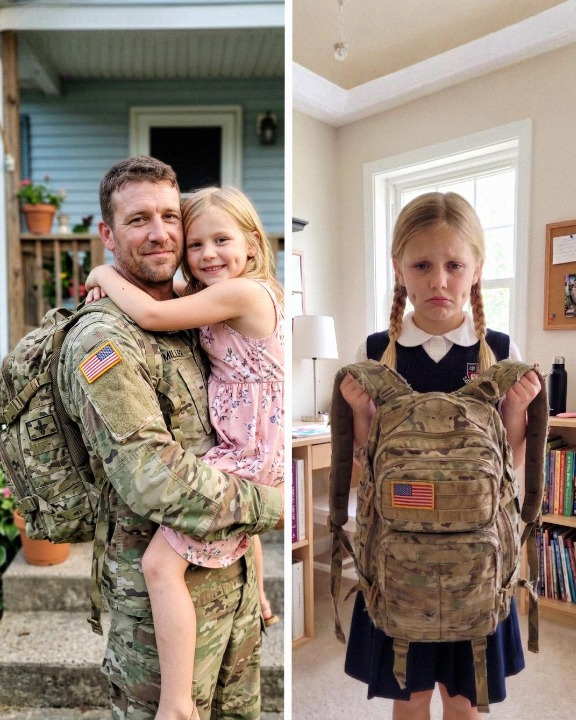
My 8-year-old daughter started getting bullied at school for carrying an old, worn military backpack—the only thing we had left of her father, who died in action overseas.
She was six when the officers came to our door. At first, she didn’t even cry. She just held onto his backpack like it was the only part of him that came home. It was faded, frayed, and dirty in places, but to her it wasn’t just a bag—it was him.
“Daddy carried this,” she kept saying.
Now she’s eight, and for nearly two years she’s taken it everywhere.
At first, I thought it was just part of her grief, so I let her keep it. When I tried to gently suggest a new backpack, she refused immediately. To her, it still smelled like her father, still felt like something he left behind for her.
I knew school might be hard, but I didn’t expect how cruel it would become.
At first it was just staring. Then whispering. Then laughing. Eventually, kids started insulting her, calling it a trash bag and saying she must be poor. Every day I asked how school went, and every day she said, “Fine,” until one afternoon she finally admitted the truth.
That’s when I went to the school.
I explained everything—her father’s death, the meaning of the backpack, the bullying. I expected support. Instead, I was told she should “adjust” and maybe consider counseling, and that removing the backpack would help her “fit in.”
They weren’t going to help her. They were asking us to erase what mattered to her.
After that, things only got worse.
One day she came home in tears after a child told her she lived in a dumpster. She stopped going to me for comfort and just shut herself in her room. Still, she refused to leave the backpack at home.
Then one morning, I got a call from her school—her teacher sounded shaken and told me to come immediately. She wouldn’t explain over the phone, only said I wouldn’t believe what had happened.
I rushed there, and when I arrived, I wasn’t alone.
I had called people who served with my late husband. They came with me.
Inside the school, I found my daughter crying, the backpack covered in food, dirt, and damage. The teacher explained that students had taken it during lunch and thrown it into the trash while laughing as she tried to get it back.
That was the breaking point.
One of my husband’s former comrades stepped forward and explained exactly what that backpack represented—what it had survived, and who had carried it.
The room went silent.
The children involved began to realize what they had done. Their parents were confronted. The school admitted they had failed to address the bullying despite earlier warnings.
My daughter was pulled into my arms, still shaking.
In the days that followed, apologies were made, disciplinary action was taken, and the backpack was carefully cleaned and repaired. It still wasn’t new, but it was respected again.
At a school assembly later, my daughter stood in front of everyone and said quietly that the backpack wasn’t trash—it was her father’s, and it helped her feel close to him. And that just because something is old doesn’t mean it doesn’t matter.
Watching her speak, I realized something I won’t forget.
Grief doesn’t disappear—it changes shape. And so does love.
Now she still carries that backpack every day. Before she gets out of the car, she always touches it once, like she’s making sure he’s still with her in the only way he can be.