
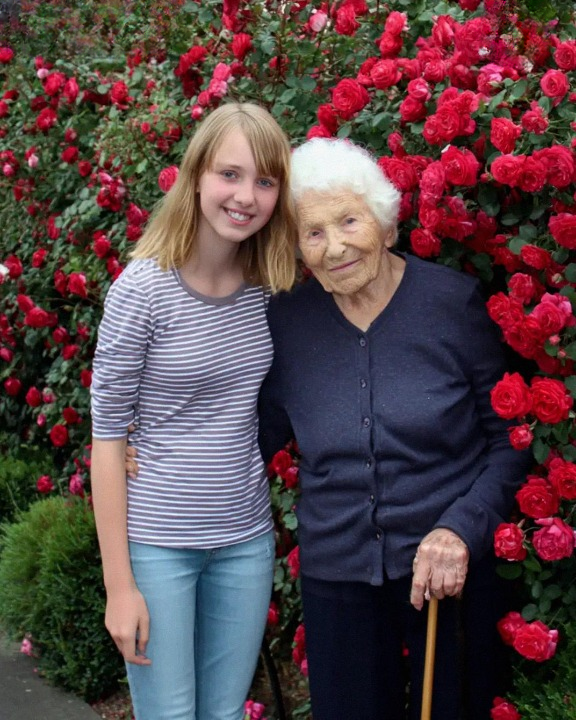
I had noticed the girl long before she ever asked for help—and once things crossed a certain line, I knew I couldn’t just look the other way.
A family moved in across the street a few months ago. From my window, I found myself watching them more closely than I’d like to admit.
There was the father, Jim. The mother, Carla. Their teenage daughter, Eva. And a baby who cried constantly.
From the outside, they seemed like any ordinary family—but it didn’t take long to notice something was off.
More than once, I saw Jim speaking to Eva in the driveway. He never raised his voice, but there was something sharp and cold in his tone—something that left no room for her to respond.
It didn’t sit right with me.
One afternoon, Jim brought Eva over to my porch.
“Would you mind letting her help with your garden?” he said lightly. “She’s a bit lazy—some work might fix that.”
I looked at Eva—standing straight, eyes lowered, hands neatly clasped.
I’m 80 years old, and since my husband passed, my home has been far too quiet.
So I said yes.
But from the very first day, I knew something didn’t add up.
Eva wasn’t lazy—not even close. She worked carefully, asked thoughtful questions, and treated every little detail in my garden like it mattered.
After that, she came every Tuesday. We tended the roses, trimmed hedges, pulled weeds. I’d give her a few dollars and invite her inside for tea—a small escape where she didn’t seem so tense.
Those visits quickly became the highlight of my week.
One day, after we finished watering the roses, Eva suddenly said, almost too quickly, “I wish I could live here with you. I feel calmer here.”
I turned to her, surprised. “Is it really that bad at home?”
She didn’t answer—but her eyes filled with tears.
That was enough.
Later, after I walked her to the door and watched her go back across the street, I turned toward my garden—and noticed something new.
A small folded note tucked under one of my rose bushes.
It hadn’t been there before.
My hands trembled as I picked it up and unfolded it.
“HELP ME. – EVA.”
For a moment, I couldn’t breathe.
I looked back at the house. No one else had been near the garden.
Before I could second-guess myself, I grabbed my cane and headed straight across the street.
The front door was already open.
Inside, I heard voices.
I stepped into the hallway—and what I saw made my heart stop.
Eva stood rigid in the living room while Jim sat in a chair, reading from a notebook like a teacher reviewing a report.
But it wasn’t schoolwork.
It was a detailed log of her life—when she woke up, what she ate, how long she practiced, even notes about her tone of voice and facial expressions.
Every minute of her day was being tracked.
Neither of them noticed me.
I didn’t hesitate. I stepped forward and said, “Hi, Jim. Sorry to come in like this—the door was open. Eva, I need your help with the roses. Right now.”
He looked startled but forced a smile. “We’re in the middle of something.”
“I won’t keep her long,” I replied, already turning toward the door.
It was a risk—but I didn’t give him time to argue.
I stepped outside and waited.
A few seconds later, I heard footsteps.
Eva followed me.
Once we reached my yard, everything came spilling out. She told me how her father had been tracking her for years—starting small, then expanding into every part of her life. Nothing she did was ever enough.
And her mother?
She stayed silent.
That note hadn’t just been about fear—it was about exhaustion.
I told Eva to hang on, to stay steady. I promised I’d figure something out.
The next Tuesday, she didn’t come.
So I made a move.
I invited Jim over for tea, pretending I wanted advice. While he talked, I let him explain everything—his “system,” his strict rules, his belief in constant control.
All the while, my phone quietly recorded every word.
The next day, I sent it to a friend who worked in family services.
She found something important—Jim had done this before, in a previous marriage.
That changed everything.
A few days later, when Jim was out, I went to speak with Carla. I told her what I knew and showed her the recording.
Instead of panic, she asked me to send it to her.
Then I waited.
Days passed in silence.
Until one afternoon, Eva showed up at my door—on a day she wasn’t expected.
She hugged me tightly.
“Thank you,” she said.
Something had changed.
Her mother had confronted Jim. The notebook was gone. The rules had stopped.
Later, Carla came by herself and explained—she had threatened to leave, to expose everything if he didn’t change.
He agreed to therapy.
It wasn’t perfect. But it was a beginning.
Life didn’t transform overnight—but it shifted.
Eva returned to the garden the following Tuesday.
And the one after that.
She still worked hard—but now, she laughed.
Not quietly.
Not carefully.
But freely.
And no one was timing her anymore.