
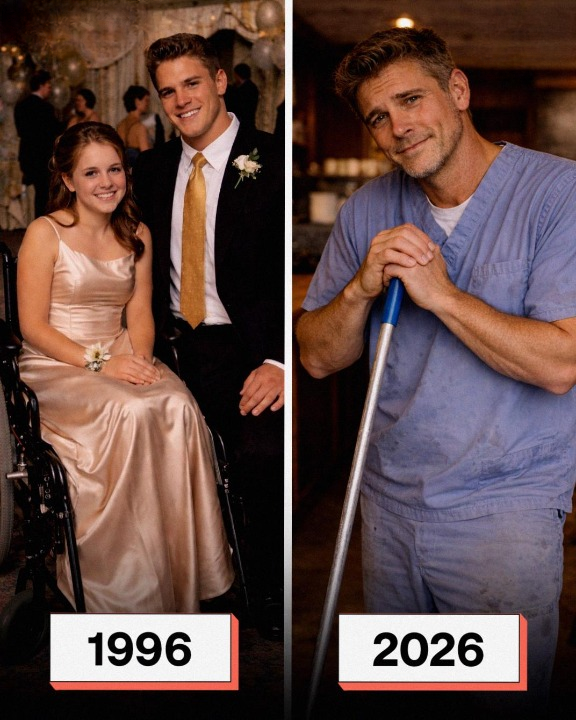
Six months after a car accident left me in a wheelchair, I went to prom expecting to be overlooked, pitied, or simply left alone against the wall. But one boy crossed the room, changed the course of that night, and gave me a memory I carried with me for 30 years.
I never imagined I’d ever see Marcus again.
I was 17 when a drunk driver ran a red light and shattered my life in an instant. One moment I was worrying about exams and prom dresses, and the next I was waking up in a hospital with doctors talking about surgeries, recovery, and uncertainty.
My legs were badly injured, my spine affected, and my future suddenly turned into a series of “maybes.”
By prom night, I told my mom I wasn’t going.
Before the accident, everything had been simple in the best way—school, friends, normal teenage worries. After it, I became afraid of being seen at all.
But my mom wouldn’t let me stay home.
She told me I deserved one night out in the world.
“I don’t want to be stared at,” I told her.
“Then stare back,” she said.
So I went.
She helped me into my dress, into my wheelchair, and into the gym filled with lights, music, and people I used to know. At first, I stayed near the edge of the room, watching everyone else belong somewhere I no longer felt part of.
People came over, said kind things, took photos… and then drifted back to the dance floor.
Then Marcus walked over.
At first, I thought he must be talking to someone else.
But he smiled directly at me.
“Hey,” he said.
When I hesitated, he gently asked if I wanted to dance.
I told him I couldn’t.
He just nodded and said, “Then we’ll figure out what dancing looks like.”
And he did.
He didn’t treat me like someone to pity or avoid. He rolled me onto the dance floor, moved with me instead of around me, and made it feel less like I didn’t belong. For a few minutes, I wasn’t the girl in the wheelchair—I was just someone being included.
When the song ended, he brought me back to my seat.
I asked him why he did it.
He simply said, “Because nobody else did.”
After graduation, life moved on. I went through surgeries, rehab, learning how to live in a body that no longer worked the way it used to. Eventually, I found my path in architecture—driven by frustration at how many places weren’t built for people like me.
Years later, I built a career designing spaces that didn’t quietly exclude anyone.
I didn’t think about Marcus again… until I was fifty.
One afternoon, I walked into a small café and spilled coffee everywhere. A man working there came over immediately to help. He moved carefully, walked with a limp, and treated me with an easy kind of kindness I couldn’t ignore.
Something about him felt familiar.
I came back the next day.
So did he.
Eventually, I said it out loud: thirty years ago, a boy asked a girl in a wheelchair to dance at prom.
He froze.
Then he remembered.
Marcus had changed too. Life had been hard—family struggles, long years of work, injuries, responsibilities that never let up. He had become someone who survived, not someone who got the life he once expected.
We talked more after that.
About what had been lost. About what had been carried too long alone.
When I offered him a role in a project at my firm—designing truly accessible community spaces—he didn’t trust it at first. But slowly, he stepped in. Not as charity, but as someone who understood what most people designing buildings never fully grasped.
He challenged ideas. He pointed out what “accessible” actually meant versus what it looked like on paper. And for the first time, his voice was taken seriously.
He eventually got medical care for his knee. Not everything could be fixed, but some things could be made easier.
More importantly, he started rebuilding a life he had put on hold.
Over time, he became part of the work—training teams, mentoring young athletes recovering from injury, speaking in ways only someone who had lived it could.
One day, I found the old prom photo of us and left it on my desk.
When he saw it, he went quiet.
“I tried to find you after high school,” he said.
And I realized then that neither of us had forgotten—we had simply been pulled away by lives neither of us could control.
His mother was finally getting proper care. His work was stable. And he had a place where he was valued not for what he endured, but for what he could give.
We didn’t rush anything. We didn’t need to.
We just… stayed.
A while later, at the opening of the community center we helped build, music filled the hall.
Marcus came over and held out his hand.
“Would you like to dance?”
I took it.
And this time, we already knew how.