
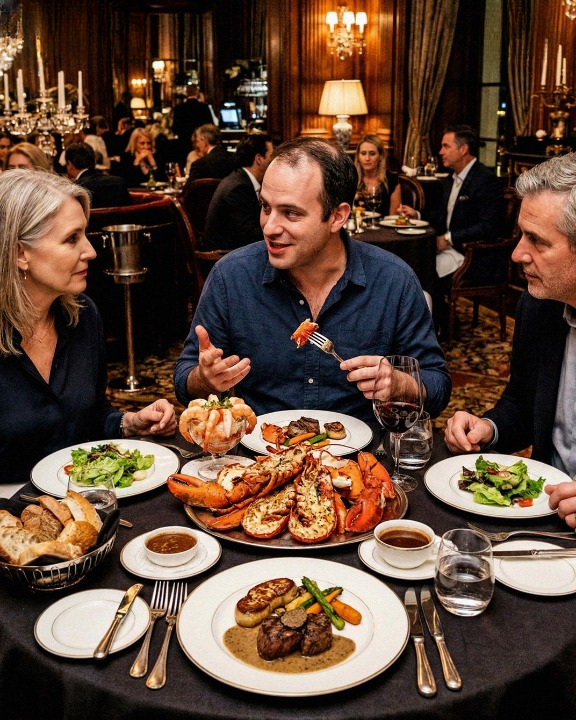
The night Elon made me cover a $2,400 dinner for his boss, he didn’t even glance at the bill. He just pushed it toward me like it was nothing. I froze because I knew that money had been carefully saved for our daughter Emma’s surgery. What happened next was something he never expected.
From the outside, people might have thought Elon and I were just a typical couple. But we weren’t. He lived as though life would always sort itself out, treating money casually and ignoring problems until they went away. He ordered extravagant meals even when groceries sat untouched, shrugged off bills, and spoke about the future as though it were guaranteed rather than something to plan for.
For months, I had been quietly saving every penny for Emma’s surgery. Every dollar counted, and I thought Elon understood that—until he handed me that dinner bill.
Earlier that evening, he announced, casually, that his boss and his wife were coming to dinner at an expensive restaurant. I asked about the cost.
“Don’t worry about it! Just look presentable,” he said.
I tried to explain that we couldn’t afford such an extravagance. He waved me off, saying, “Relax. This is important.” But what mattered most to me was Emma, not impressing someone.
At the restaurant, Elon ordered lavishly—lobster, shrimp, Kobe beef, and the most expensive wine. When the bill arrived, he slid it to me with a casual, “With your card.” My heart sank. $2,400—money I had painstakingly set aside for our daughter.
I signed the bill silently, knowing arguing wouldn’t save it. Elon’s smug satisfaction was immediate. But then Mr. Carter, his boss, asked about Emma’s surgery. Without hesitation, I pulled out Emma’s medical paperwork, showing every detail.
The shift was instant. Mr. Carter realized Elon had lied about his priorities. The promotion Elon had hoped for vanished in a single moment.
“Your wife mentioned your daughter. Emma, was it? What kind of surgery does she need?” Mr. Carter asked.
I explained calmly and clearly that this was a necessary surgery, and I’d been saving for months. Elon tried to downplay it, but I offered proof—hospital contacts, estimates, and payment plans.
The truth was undeniable. Mr. Carter turned to Elon, saying, “You told me you were ready for responsibility… but that’s not the man I thought I was investing in.”
Elon sat stunned, defeated for the first time all evening. Mrs. Carter then turned to me. “Would you consider working with us, Regina?” she asked.
For the first time that night, I felt seen rather than overlooked. “I’d like to,” I said softly.
I left the restaurant without looking at Elon. He followed, but I knew the choice I had to make. “You made your choice tonight,” I told him. “I’m making mine.”
Later, sitting beside Emma as she slept, I held her hand and realized that though a large part of what I had saved was gone, I had found a new way forward—a way that didn’t depend on Elon.
He thought one dinner would change his life. It did—just not in the way he had planned.