
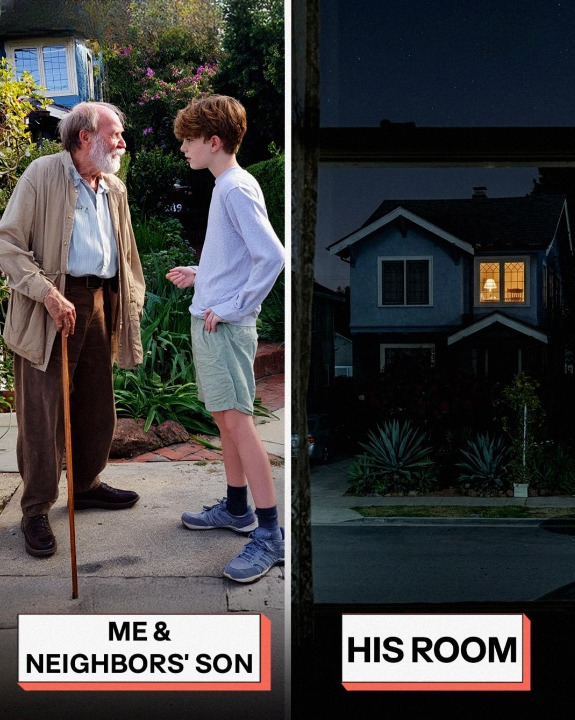
For weeks, the teenage boy across the street had been signaling S.O.S. in Morse code from his bedroom window. As a former Marine, I initially thought he was just fooling around and told him to stop. But one night, when the message changed to “WE NEED YOUR HELP,” I realized he had been reaching out for real all along.
My name is Harold. I’m retired from the Marines, though now my biggest battles are with creaky knees. I lived quietly in a small house for years—until a new family moved in across the street: a couple in their 40s with a teenage son and a younger daughter. They looked perfect from afar, but appearances can be misleading.
They introduced themselves the very next day. The father, David, shook my hand firmly, the mother, Sarah, offered a cherry pie, and their kids—Leo and Mia—stood quietly in the background. Leo, the teen, kept his head down and hands buried in his pockets; Mia waved innocently.
Days passed. I watched the family from my porch, mostly keeping to myself. Then one afternoon, David and Leo were outside throwing a ball. At first, it seemed casual, but I noticed David’s strict coaching, his sharp corrections, and Leo’s growing frustration. When I offered advice, Leo actually nodded and improved his throw—then glanced at me with a silent “thank you.”
Then, the strange signals started. Late one night, I noticed a rhythmic flashing: three short, three long, three short. S.O.S. My pulse raced. The next morning, everything across the street appeared normal, but the signals kept repeating nightly.
At first, I assumed it was a prank. On the fourth night, I flicked my lamp once, and the light went off immediately. A couple of days later, I intercepted Leo at the mailbox.
“Son, don’t use that signal for nothing. It’s serious,” I warned.
“I never joke, sir. Watch your window carefully,” he replied with a calm, steady tone that didn’t match his age.
The signals stopped for a few nights. But one Monday, just before bed, I saw them again—not S.O.S., but “WE NEED YOUR HELP. COME INTO THE HOUSE.” A chill ran down my spine. Vietnam had taught me to trust that gut feeling.
I went outside and saw their front door wide open. Inside, there was a loud crash and shouting. I entered cautiously. A side table had been overturned, drawers spilled. David was red-faced and shouting at Leo, who was standing his ground.
“You’ve been signaling me?” I asked.
Leo didn’t flinch. “I needed someone to see me, sir.”
The argument revealed their conflict: David had grand plans for Leo—prestigious schools, a safe career—but Leo wanted to become an EMT, to serve people directly. David wanted stability; Leo wanted meaning.
I spoke up, seeing Leo’s resolve: “Pressure can build strength, David, but if you don’t know when to let off the gas, it just makes dust. You’ve got a good man standing right in front of you. Don’t break him.”
A week later, Leo came to my door. He wanted guidance on first aid. We focused on the basics: staying calm under pressure, controlling adrenaline, and helping others in emergencies. Slowly, David began to respect his son’s choices, learning to listen and let Leo grow into his own path.
One night, I noticed Leo signaling from his window again. I flicked my lamp once in response. Message received. I went to bed smiling, knowing I had helped make a difference.