
I’ve witnessed grief in many forms over the years, but I never imagined it would unravel so painfully inside my own home. What my grandson created to heal his heart nearly shattered him all over again.
My name is Ruth. At my age, I’ve learned that when someone dies, their presence doesn’t truly leave—it lingers in quiet corners, in memories, in the things they leave behind.
My grandson Liam is nine. We live together with his father, Daniel. Two years ago, we lost Liam’s mother, Emily, to cancer. She was the kind of woman who brought warmth into every room without trying. When she passed, something inside Liam dimmed.
Not suddenly. Not in ways others easily noticed.
But I saw it.
He stopped laughing the same way. Stopped running to the door. Stopped asking for things. He didn’t break down—he just quietly adapted.
The only thing he held onto were his mother’s sweaters—handmade, soft, still faintly scented with her lavender detergent. He kept them carefully folded in a box, sometimes just sitting beside them in silence.
A year later, Daniel remarried. His new wife, Claire, made it clear early on that those sweaters didn’t belong in what she called “her home.” Daniel brushed it off, asking for patience. For Liam’s sake, I stayed quiet.
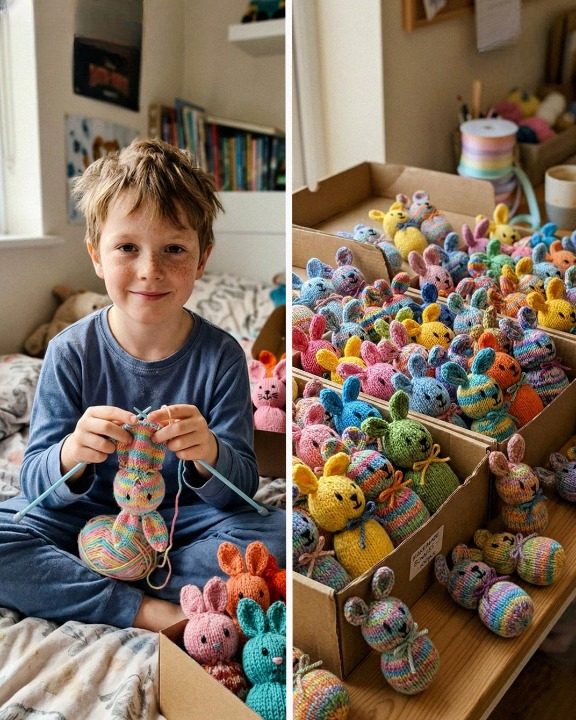
Then, a few weeks before Easter, Liam showed me something he’d made—a small, uneven bunny.
“I made it for kids in the hospital,” he said softly. “So they won’t feel alone.”
My heart nearly broke.
When I asked why a bunny, he smiled faintly. “Mom used to call me her bunny.”
From that moment on, he worked tirelessly. Every day, he unraveled his mother’s sweaters, turning them back into yarn, then knitting bunny after bunny. They weren’t perfect, but they were made with love.
Each one carried a small message:
“You are not alone.”
“You are brave.”
“Keep fighting.”
He made one hundred.
For the first time in years, I saw a spark return to him.
Then everything fell apart.
The day before we planned to deliver them, Claire saw the boxes. Without hesitation, she picked one up, scoffed, and called them “trash.”
Before I could stop her, she carried them outside—and dumped them into the dumpster. Box after box.
Liam didn’t scream. He just stood there, trembling, before quietly breaking into tears.
That silence was worse than anything.
Then Daniel came home.
For once, he didn’t defend her.
Instead, he brought out a small wooden box—something clearly precious to Claire. Inside were old letters and photos of a man she once loved deeply.
“Should I throw this away too?” he asked calmly.
She froze.
Then he told her to go outside and retrieve every single bunny.
And she did.
Without protest, without pride, she climbed into the dumpster and recovered each one—dirty, crushed, but still there.
That night, Daniel made it clear: she could not erase Emily or hurt Liam again.
The next day, Claire apologized.
Not perfectly. Not dramatically. But honestly.
She admitted she had tried to push Liam to let go of his mother so there would be room for her—and realized too late how wrong she’d been.
Then she did something none of us expected.
She emptied her own keepsake box and handed it to Liam.
“Can we start over?” she asked.
After a long pause, he hugged her.
Weeks later, the repaired bunnies were delivered to the hospital. Claire went with him, quietly supporting him every step of the way.
On the drive home, Liam looked out the window and said softly,
“Mom would’ve liked that.”
Claire didn’t respond.
She just nodded.
And for the first time, I believed she might finally understand what it means to truly be part of this family.