
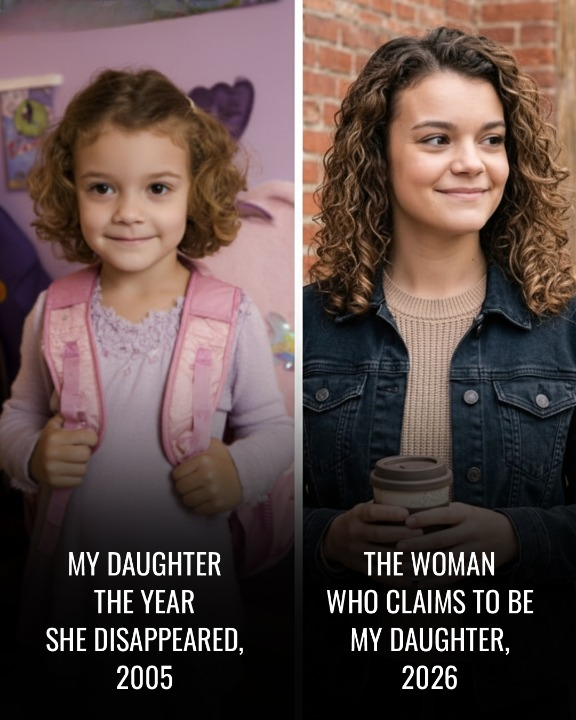
Twenty-one years after my daughter vanished from her kindergarten playground, I thought I had made peace with the loss. But on what would have been her 25th birthday, a plain white envelope arrived. Inside was a photo and a letter that began, “Dear Mom.”
For two decades, I had preserved Catherine’s room exactly as it had been: lavender walls, glow-in-the-dark stars, her tiny sneakers by the door. Even opening the closet still carried the faint scent of her strawberry shampoo.
She disappeared at four, wearing a yellow daisy dress and mismatched barrettes because, as she said, “princesses mix colors.” That morning, she asked, “Curly noodles tonight, Mommy?” I laughed, Frank grinned, and the playground looked ordinary—but in an instant, she was gone. Ten minutes later, when the school called, I was rinsing a mug, unaware.
Her backpack lay by the slide, tipped and empty, her red mitten bright in the mulch. The police asked questions that cut like knives. “Anyone close to the family?” they asked. Frank’s hands tightened, knuckles white. “Because I failed her,” he admitted later.
Three months afterward, Frank collapsed while fixing a cabinet, a “broken heart” the doctor called it. I had buried my husband while my daughter was missing—my grief had no priority.
Years passed. Each birthday, I lit a candle for Catherine, whispered her name in the rocking chair, praying or daring her to come home. Then, on her 25th birthday, the envelope appeared. Inside was a photo of a young woman with my face and Frank’s eyes, along with a letter:
“You have no idea what happened that day. The person who took me was NEVER a stranger. Dad didn’t die. He faked my kidnapping to start a new life with Evelyn, who couldn’t have kids.”
At the bottom was a phone number and a message: come meet me at the building in the photo. I called immediately.
When we finally met, Catherine—now going by Callie—was wary, scanning her surroundings, panic lurking beneath her calm. She handed me a folder containing name-change documents, fake custody papers, and bank transfers under Frank’s name. A blurry photo showed him alive.
Frank’s second life crumbled under scrutiny. Evelyn tried to defend her actions, but Catherine’s voice cut through: “You locked me up and called it love. You don’t get to be my dad.”
With the police watching, justice began to catch up. Frank faced legal consequences, Evelyn’s grip on their fabricated life ended. Slowly, Catherine returned to her real life, rediscovering her childhood room, the lavender walls, the sneakers.
We rebuilt together, step by step: tea on the porch, quiet walks, photo albums opened when she asked. On her next birthday, we lit two candles: one for the child she was, and one for the woman she had become. And for the first time in twenty-one years, the room felt like home again.