
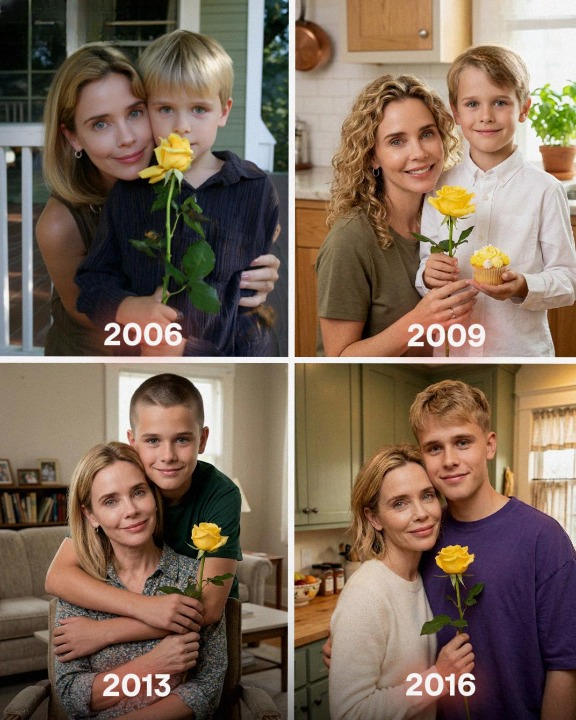
My stepson disappeared from my life for ten years. Then, on my sixty-second birthday, the doorbell rang—and all I found was a dried yellow rose lying on my doorstep.
It rang twice.
When I opened the door, no one was there. Just that single, lifeless flower.
My knees nearly gave out.
For a moment, I wasn’t sixty-two anymore—I was thirty-five, opening the door to a shy little boy with dirt on his hands and a flower hidden behind his back.
Stephen was only five when I married his father. His mother hadn’t passed away—she had simply left.
During my first week in the house, he had asked quietly, “Are you staying?”
I smiled and said, “Do you want me to?”
He shrugged, but not long after, he began calling me Mom—first by accident, then on purpose.
I raised him. Packed his lunches. Sat through school plays. Stayed up through fevers. Loved him like he was my own.
Every year on my birthday, he brought me a yellow rose.
At first, he picked them from neighbors’ gardens and called it “borrowing.” Later, when he got a job, he bought them himself, saying mine should always be perfect.
Those flowers became our tradition.
Then everything changed.
After my husband died suddenly, Stephen began to pull away. He took calls in secret, grew distant. I thought it was grief.
Until the day I came home and found him packing a bag.
“I’m leaving,” he said.
“With who?” I asked.
“My mother.”
The words froze the room.
He told me she had found him months earlier—and that she had told him everything.
According to her, I had been the reason their family fell apart. That I had stolen his father away. That I had lied.
I tried to explain, but he wouldn’t listen.
“I only stayed for Dad,” he said coldly. “I was never really your son.”
Then he walked out.
And just like that, he was gone.
No calls. No messages. No trace.
For ten long years, I lived with that silence—and the doubt it left behind.
So when I saw that dead yellow rose on my birthday, something inside me knew it was from him.
Tied to the stem was a note:
“I had to make you hate me.”
Inside, there was more—a hospital bracelet with a baby girl’s name.
My name.
And another letter, in Stephen’s handwriting.
He wrote that I had been the first real home he ever knew. That he had named his daughter after me. That he knew he didn’t deserve forgiveness—but hoped she would know the woman who raised him.
There was also a key. And a deed.
A small seaside cottage—paid in full, in my name.
In his letter, he explained everything. After his father’s death, his biological mother had reappeared, feeding him lies. He believed her—until the stories stopped making sense.
Eventually, he found proof. Documents. Letters. Evidence that she had left long before I came into the picture. That his father had tried to find her—and she never answered.
Then he found a letter his father had written years earlier:
“If anything happens to me, stay with your mom. Love made her your parent—not blood.”
By then, too much time had passed. Shame kept him away.
But he never forgot a promise.
As a child, I had once joked that he could buy me a little seaside cottage someday.
He did.
At the end of the letter, he asked me to meet him there.
I didn’t sleep that night.
The next morning, I drove to the coast with that dried rose beside me.
The cottage was exactly as I had imagined—small, white, overlooking the water.
And Stephen was there.
Older. Different. But still him.
We stood in silence until he finally whispered, “Hi… Mom.”
I told him he didn’t get to start there.
He nodded, tears in his eyes.
He explained that when his daughter was born, he finally understood what he had done. The thought of her looking at him the way he had looked at me—it broke him.
“That’s what I did to us,” he said, looking at the dead rose.
I told him the truth—that he had shattered me. That I had spent years questioning every memory, every moment, every piece of love we had shared.
He cried. Apologized. Admitted the cruel words he’d said were lies meant to make leaving easier.
“I loved you,” he said. “I always did.”
That was when I finally broke.
After a long silence, he asked quietly, “Do I still get to call you Mom?”
I looked at him—and at everything we had lost.
“Not for free,” I said.
I unlocked the cottage door. Inside were pieces of memories he had held onto—small things I once loved.
On the mantel was a photo of a newborn baby.
She deserves to know her grandmother.
I held it close.
“You can call me Mom,” I told him, “when you earn being my son again.”
He nodded.
A few days later, he came to my house with his daughter.
I took her in my arms, and something inside me softened.
The following year, on my birthday, the doorbell rang again.
This time, when I opened it, Stephen stood there—holding his daughter…
And a fresh yellow rose.
“Happy birthday, Mom,” he said.
And this time—he stayed.